





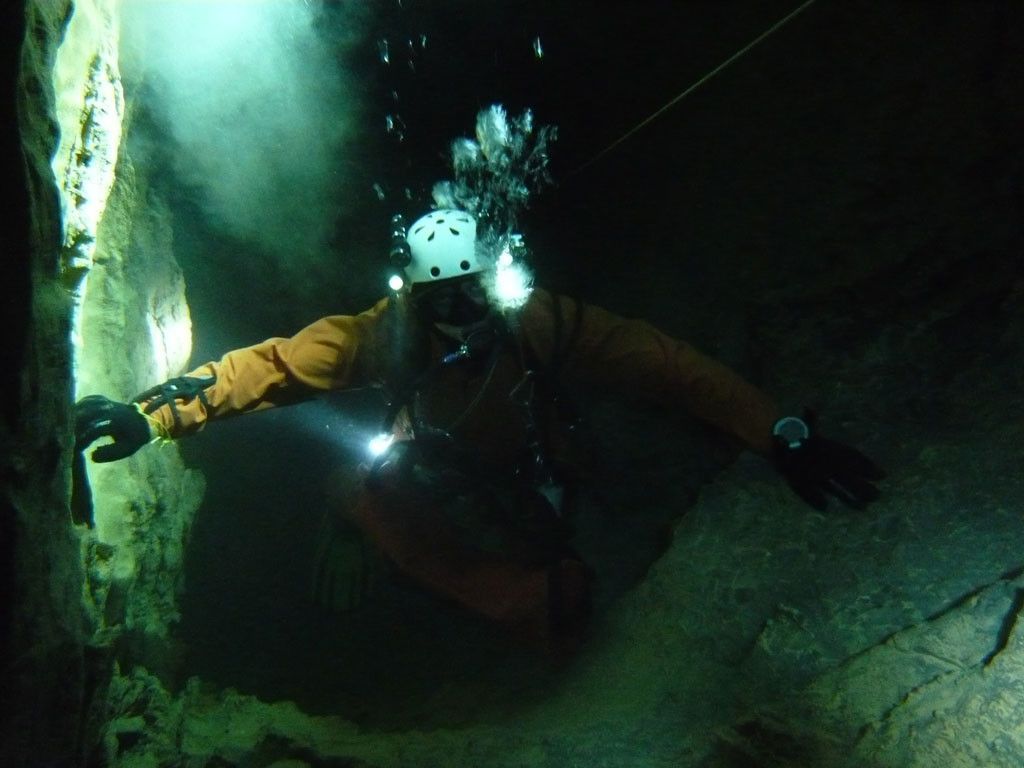
We can say that Grignetta is to Lecco mountaineering what Bobbia is to local cave divers . Easy to reach, less than an hour's drive, it offers a variety of activities, from the simplest to the most challenging, in an environment as harsh as it is spectacular, just like Grigna Meridionale. A visit can be incredibly rewarding for those who venture there with the right knowledge; indeed, to venture beyond the first siphon requires excellent speleological and cave diving training.
The cave has always been known to locals, while its speleological history began with the first explorations in the late 1970s. Thanks to a long dry spell, the first siphon dried up, allowing exploration of almost 150 meters of the cave until reaching a second siphon, this time permanent, where explorations stopped.
Almost ten years passed before the decision was made to undertake the dive, and in 1986 the Lecco Speleological Group (CAI Lecco) succeeded in the undertaking, also overcoming a third and longer siphon and doubling the overall length of the cave.
Beyond, the cave's morphology changes, the spaces become larger, internal lakes follow one another, rooms and meanders, with beautiful concretions preserved for thousands of years thanks to the siphons. Those fortunate enough to venture into these areas have an absolute obligation to safeguard them, paying careful attention and trying to minimize human impact on this fascinating yet delicate ecosystem.
As in the past, a new siphon halts the explorers, but this time the distance from the entrance and the logistical challenges seem insurmountable. Between the siphons, in fact, two narrow meanders, some of which are in opposition, seem to break the spirits of even the most masochistic speleologists.
It was at this point that a young man from Lecco, Luigi Casati, a promising figure in Italian underwater speleology, entered the cave's history. Between 1987 and 1988, he surpassed the fourth siphon and free climbed the waterfall just beyond, reaching the fifth siphon after a few more short climbs.
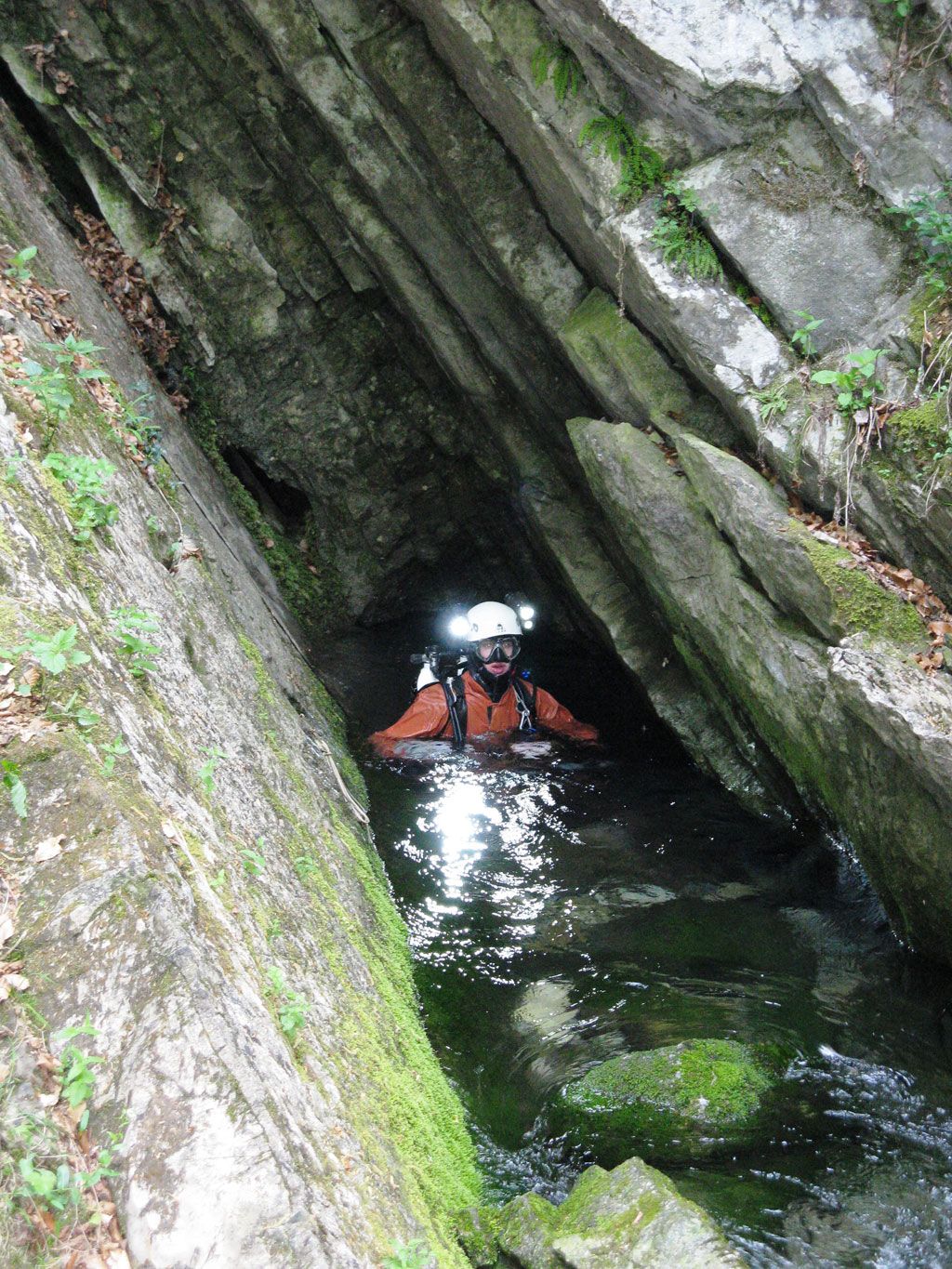
The stays inside the cave become increasingly longer and more demanding and also involve Swiss cave divers, of whom Gigi was initially a student and now also an exploration companion.
Regardless of the difficulties, they organized a dive attempt to the fifth siphon, which immediately met their expectations. Casati explored and passed the fifth siphon, which, at one hundred meters long and with a maximum depth of twenty-five meters, is currently the longest and deepest in the cave. Beyond the cave, the incessant flow of water that feeds it only allows itself to rise a few meters to yet another siphon, the sixth.
The new obstacle leads to two attempts to overcome it, but this time the cave resists their assaults, concealing its secrets and putting an end to the search for the source of its watercourse. Despite his efforts, Gigi twice stalls in narrow passages, where poor visibility and the torches, now reduced to tiny lights from hours of being burned, prevent him from finding the right path.
Enthusiasm wanes, and the cave deflects the attacks of other speleology teams, until it is virtually abandoned. Only small groups of cave divers visit it occasionally over the years, never venturing into the more remote areas.
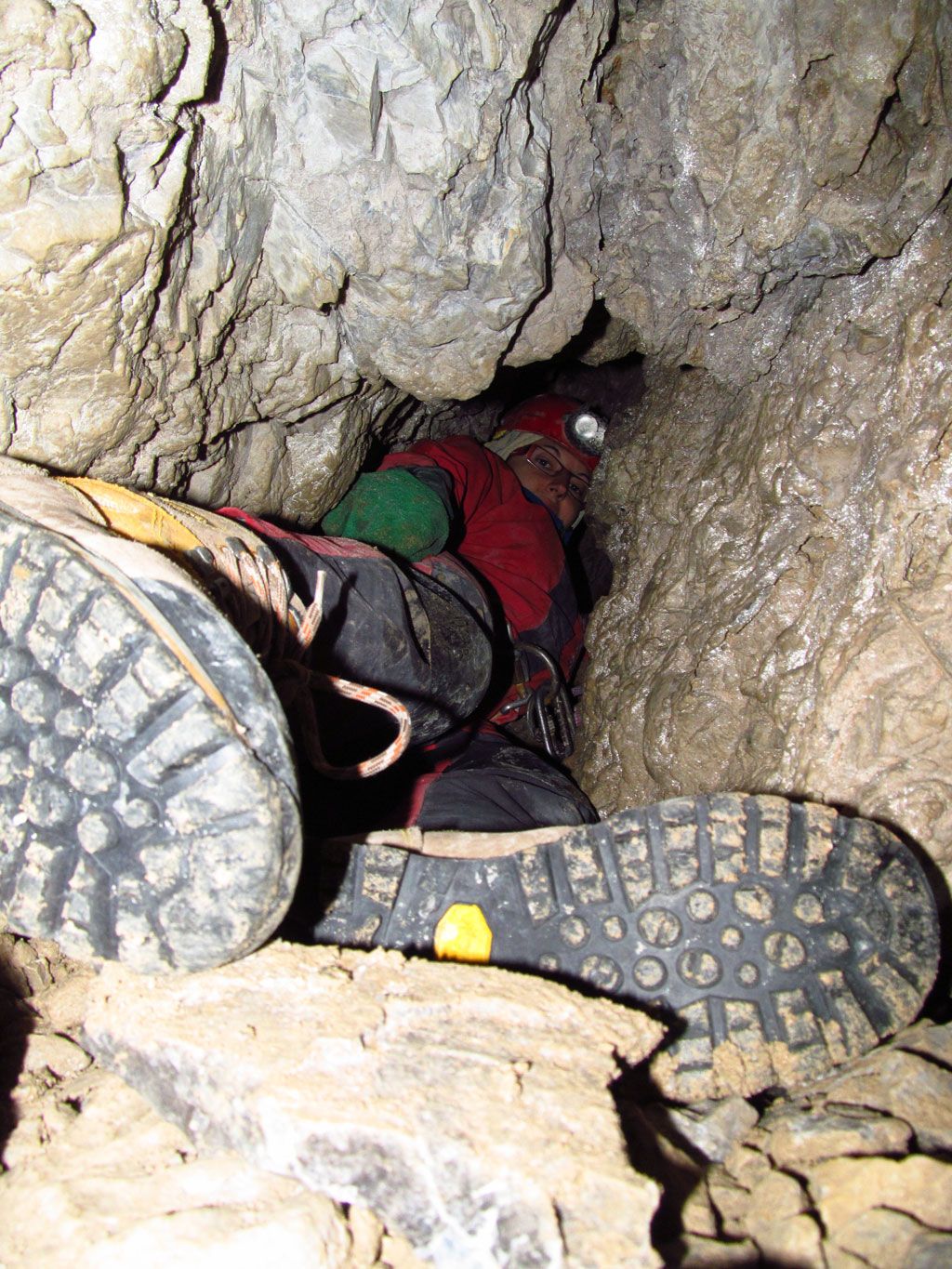
But as with all caves, sooner or later someone returns, driven not only by the curiosity of seeing a place they've never visited before, but also by the desire to go even further, to answer the question: "What lies beyond?"
Thus, in early 2009, a small group of cave divers, united by their passion and training (they were all Casati's students), was formed and decided to resume the cave's investigation. They were Nadia Bocchi, Mario Comi, Davide Corengia, Stefano Gallingani, and Luca Pedrali.
During the outings, the cave is re-routed and cleaned of old wires that make re-entry dangerous in poor visibility. Various photographic material is collected, and after almost twenty years, Luca and Davide return beyond the fifth siphon of the cave.
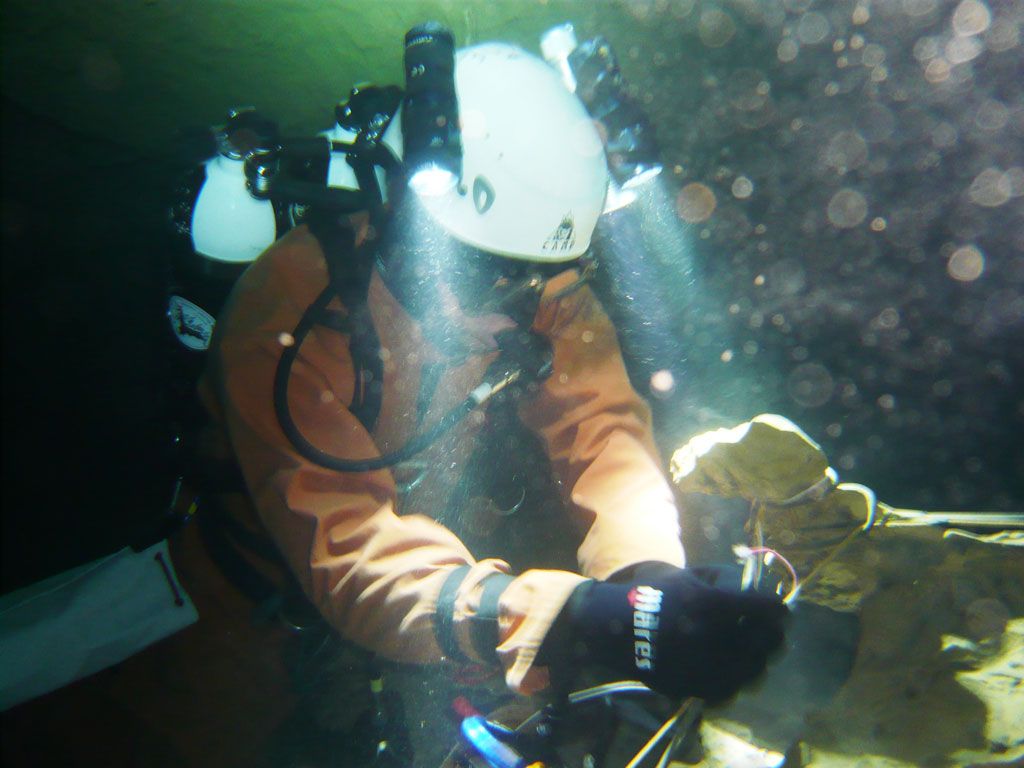
Being so close to the exploration limit is enough motivation to organize an attempt soon, to see the sixth one as well. This time, Stefano and Davide surpass the fifth one, allowing at least one of them to dive into the sixth and last known siphon of the cave. Davide is the lucky one, and in twenty minutes of diving, he re-snorts the sixth siphon until he reaches the narrow area where Gigi had stopped more than twenty years earlier.
The enthusiasm is immense; so much so that they push them—and succeed!—to rekindle in Gigi the desire to return to the cave that had seen him protagonist at the beginning of his career.
In mid-July 2012, the team of Luca, Stefano, Davide, and Gigi organized the exploratory expedition, and finally, after many years of waiting, Gigi managed to find the right route, passing the sixth siphon. Beyond that, after a few meters, he found himself in front of a new siphon, which he had partially explored to date down to -20 meters... but the new exploratory history of the cave is just beginning.
(re)started….
Text authors: Luana Aimar, Valeria Nava, Antonio Premazzi
Photos by Davide Corengia, Luca Pedrali, and Stefano Gallingani
Piani di Bobbio: geographical and geological context
By Luana Aimar & Antonio Premazzi
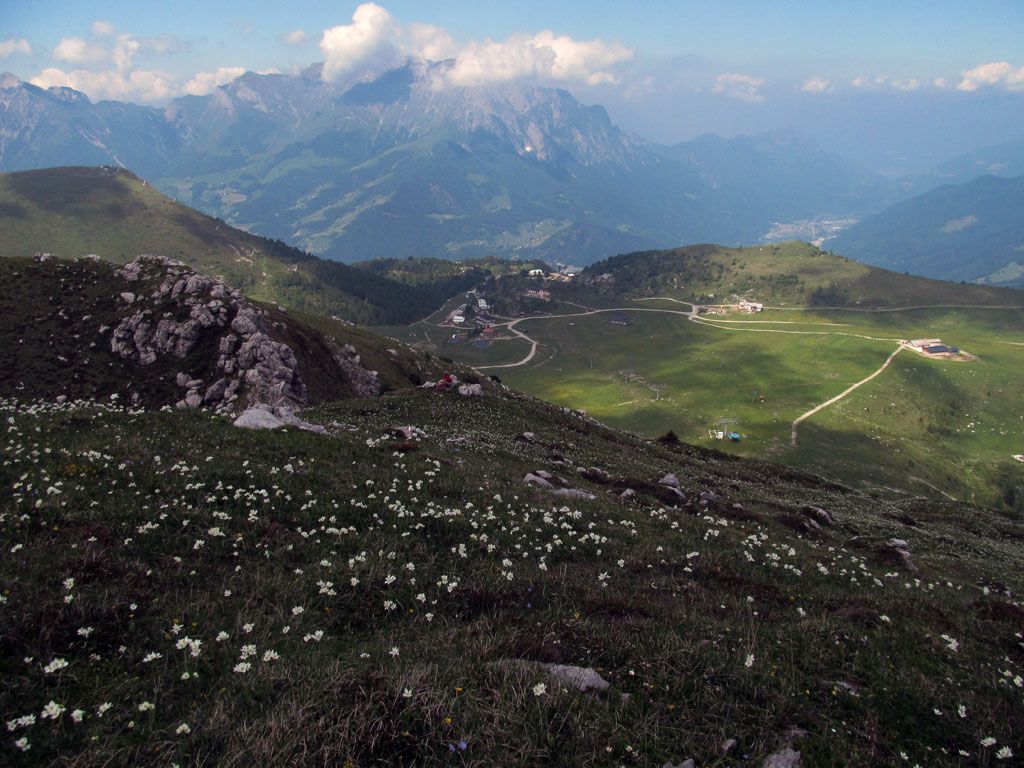
The Piani di Bobbio extend across the provinces of Lecco and Bergamo and consist of a succession of karst plateaus at altitudes between 1650 and 1750 m above sea level, bordered to the east by a steep mountain range with a south-north orientation, dominated by Zuccone Campelli (2192 m), and which continues with Zucco Barbesino (2132 m) and Corna Grande (2087 m). To the south and west, after the Zucco Orscellera peak, the plateaus slope rapidly towards Valsassina, with a sharp drop of 1000 metres, while to the north they descend more gently towards Valtorta.
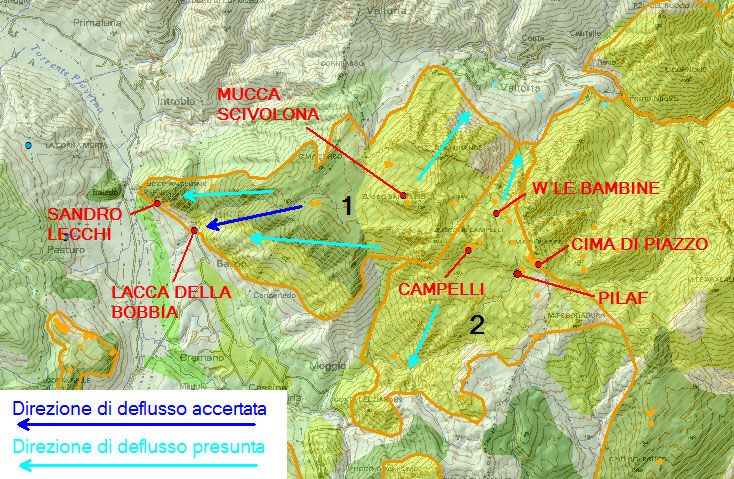
At the base of the plateaus lies the Praterino area, where two important resurgences have been explored by cave divers over the decades: the Sandro Lecchi cave, which extends for more than 600 meters, and whose exploration is currently at a standstill on a siphon with a landslide; and, most importantly, the Lacca della Bobbia, whose exploration limit, corresponding to a submerged narrowing of the sixth siphon, was recently surpassed by Gigi Casati, who partially explored a seventh siphon down to a depth of -20 meters.
It is also well known that in the early 1990s, an accidental and involuntary "tracing test" occurred. During the cleaning of a tank at the arrival station of the Piani di Bobbio cable car, above 1600 meters above sea level, large quantities of oil—although the data is unconfirmed, it is estimated to be approximately 10,000 liters of fuel—disappeared between the rocks, disastrously polluting the waters of the Lacca della Bobbia. The phenomenon, which caused oily stains in the water and visible foam, continued for several years and was particularly serious because the waters from the resurgence were (and are!) captured by the aqueduct of the nearby town of Barzio. This event demonstrates the existence of a hydrological connection between the two resurgences and the absorption zones of the Piani di Bobbio above.
Based on data collected after heavy rainfall, the water flow appears to be very rapid, indicating a possible marked verticalization of the underground voids; however, given the size of the area, development also has the potential to extend over several kilometers.
Moving south, you'll encounter the Piani di Artavaggio, similar to the Piani di Bobbio in shape and elevation. Caves of undoubted interest have been explored in this second area in the past, such as the Campelli Abyss, by far the largest cavity in the area, with a depth of -483 m and a length of over a kilometer, and the Pilaf Abyss (-113 m), consisting of a series of parallel shafts connected by windows.
The Bobbio Plains are covered by an extensive layer of glacial and slope deposits. The former, in particular, display beautiful glacial morphologies, such as ridges or small moraine arches, corresponding to modest glacial cirques, for example in the Megoffi Valley and the Camosci Valley.
Surface karst is clearly evident, however, the extensive forest cover of tall trees up to an altitude of 1600 meters and the subsequent presence of dense shrubby vegetation along the slopes of the ski lifts tend to obscure the surface features of the land. However, near the Piani, the vegetation cover is predominantly grassland, and the karst phenomena appear much more evident.
There are a large number of sinkholes measuring tens of metres in diameter, but the largest ones are undoubtedly found in the two glacial cirques of the Valli dei Megoffi and Valli dei Camosci.