



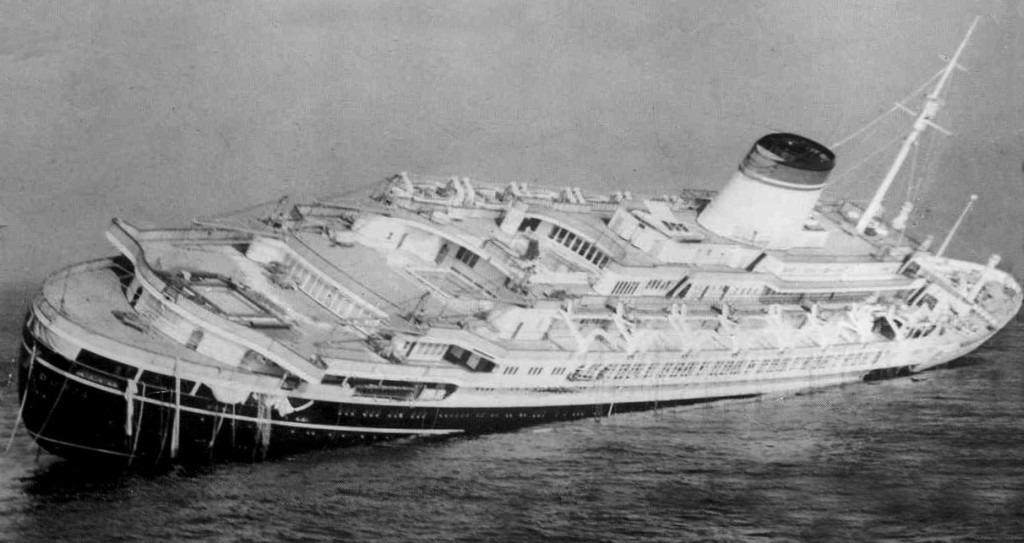
The Andrea Doria was built at the Ansaldo shipyard in Sestri, Genoa, and launched in 1951. She could carry 1241 passengers and 575 crew. She was luxurious down to the smallest detail of her facilities and was considered the flagship of the Italian Lines.
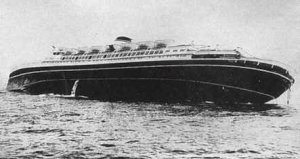
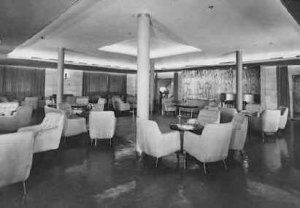
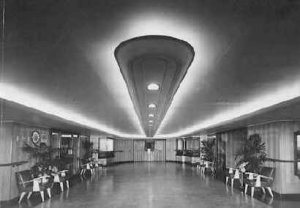
The jet set of the time were on board, and its holds were always filled with the most diverse goods, such as a prototype of a car built by the Ghia body shop commissioned by the American Chrysler. The name Andrea Doria derives from a sixteenth-century admiral who heroically defended Genoa against its numerous enemies. The luxury cruise ship was 210 meters long and approximately 27 meters wide. It displaced 29,083 tons, had ten decks, and eleven watertight compartments along the entire length of the ship. It was equipped with two turbines developing 50.000 horsepower to turn the two three-bladed propellers, each weighing 16 tons. It was also equipped with lifeboats capable of carrying 2000 people, a highly sophisticated fire-fighting system, and radar.
At 23:22 PM on July 25, 1956, during her 101st voyage, while sailing through dense fog, under the command of Captain Piero Calamai, the Andrea Doria and the Swedish cruise ship Stockholm, under the command of Captain Nordenson, collided. The disaster has no logical explanation. It could and should have been easily avoided, but radar readings aboard both ships were mysteriously overlooked. The Stockholm, though seriously damaged by the collision and with her bow completely destroyed, remained afloat. The Doria, however, was fatally damaged, began taking on water through the breach in her side and listing to one side.
The following radio messages were transmitted after the collision.
At 11.22pm (Stockholm) “We have collided with another vessel,” 11.35pm (Doria) “We are too inclined and unable to launch lifeboats, we require immediate assistance,”
24:09 (Stockholm) “Heavily damaged. The bow is completely destroyed, engine no. 1 is full of water. We cannot move from our position.” The messages continued throughout the night, documenting this tragedy at sea minute by minute.
The arrival of the French cruise ship “Ile de France” was providential, saving a large number of shipwrecked people and for this reason it was considered the heroine of the rescue operation.
At 04,30 hours, Robert Hudson, the last passenger, was rescued by the tanker Robert E. Hopkins.
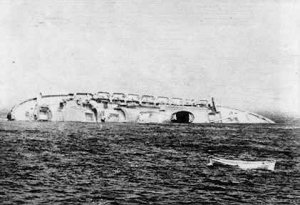
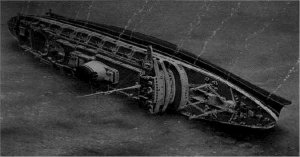
Eleven hours after the collision, the Andrea Doria sank, and the moment was filmed and broadcast live. Of the 1706 passengers on board, 46 died, most due to the initial impact.
A day after the Doria sank, Peter Gimbel and Joseph Fox became the first divers to visit it. Gimbel located the wreck using the yellow buoy placed by the Coast Guard. The two divers found it lying on its side at a depth of 48 meters and began taking photographs. Gimbel's black-and-white photos were purchased by Life and published in the August 6 and 13 issues.
LIFE immediately hired Gimbel to take additional photos, this time in color.
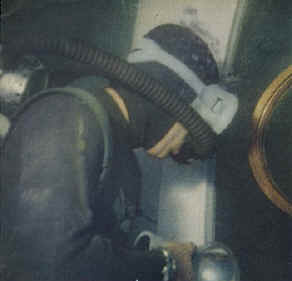
In 1973, Peter Gimbel began his work recovering the Doria's safe. By 1981, he had not only succeeded in the recovery, but solved the mystery of how a ship thought to be unsinkable, with watertight compartments to prevent the spread of water, could have been.
The Doria had suffered an impact that had caused a 24-meter gash that had punctured some of its watertight chambers. This gash allowed a large amount of water to enter the hull, causing it to list 20°. The safety measures had been designed for a vertical hull; the large amount of water that had entered passed laterally over the watertight doors, causing the disaster.
The safe recovered by Gimbel was placed in the shark tank at the New York Aquarium. Everything was arranged so that its opening would be broadcast live on national television. On August 16, 1984, the safe was opened. Inside, US silver certificates and Italian notes were recovered.
Today, the Andrea Doria lies on its side at a depth of approximately 74 meters. Its hull is currently known to a small number of divers and is considered the same as Mount Everest to climbers. To dare to explore requires facing nitrogen narcosis, lengthy decompression, freezing water, strong currents, sharks, and long surface intervals to reach the site and between dives.
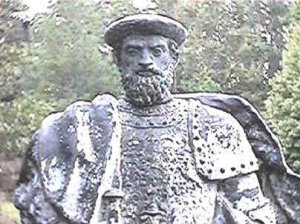
Gary Gentile, author of the book "ANDREA DORIA, DIVE TO AN ERA," has conducted several expeditions to this wreck. On one of these dives, he and his team recovered the stern bell. During these various recovery expeditions, the statue of Andrea Doria, which once dominated the ship's main saloon, was also found. It is currently located in the private garden of a villa in the United States. Many divers who visit this wreck are thrilled to find several pieces of Chinese porcelain that were part of the ship's equipment, pieces that become the property of the finder.
The expedition on the Andrea Doria
I think an expedition on the Andrea Doria is every diver's dream, especially for us Italians. The ship has become part of the history of the Italian Merchant Navy, and is well-known even to those who don't deal with maritime matters.
Diving on the Doria truly represents a high-level technical achievement as a diver. An expedition on the Doria arouses interest among divers and non-divers alike, given the exceptional nature of the event in which the cruise ship was involved. Further proof of this is the breaking news that a film about the Andrea Doria shipwreck is being produced in the United States.
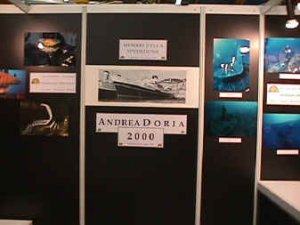
What better occasion than the year 2000 to commemorate the loss of the cruise ship, considered the most elegant and luxurious to ever sail the world's seas, by unveiling a commemorative plaque. The Doria Survivors' Association has already confirmed its official sponsorship of the expedition, and we are in contact with other interested individuals and organizations.
To organize an expedition of a high technical and organizational level, we asked for the collaboration of the best people and structures that the technical diving market can offer.
On-site organizational manager Joel Silverstein, Technical Instructor Trainer for various agencies, author of several manuals on diving with gas mixtures other than air and with more than 40 active expeditions on the Andrea Doria.
Responsible for planning the dives is Dr. Bill Hamilton, a leading expert on technical diving physiology and creator of the Repex method for calculating pulmonary oxygen toxicity.
The vessel at our disposal is the ocean research vessel WAHOO, with dozens of successful expeditions to the wreck of the Andrea Doria, under the leadership of Captain Steve Bielenda.
The program of the expedition on the Andrea Doria
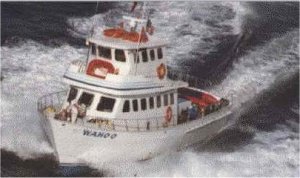
Arrival Thursday, June 29, 2000. Group and luggage transfer from Kennedy International Airport to Captree State Park on Long Island, where the boat we will be using, the "Wahoo," is docked. Friday is dedicated to delivering and preparing additional equipment and tanks. Saturday and Sunday include two dives on the wreck of the USS San Diego and two on the SS Oregon (30-40 meters).
Monday, transfer to Montauk, Long Island (approximately 3 hours). During your stay in Montauk, you'll have free days to relax, enjoy sports, and indulge in American cuisine (diving is prohibited). Meanwhile, the boat, complete with all the equipment, will be transferred by sea and all the necessary gear, refueling, food supplies, and everything else needed for the trip and diving aboard the Doria will be prepared.
Depending on weather conditions, we will depart from Motauk on Monday or Tuesday evening, arriving at the dive site the following morning. We will stay on site for two days (or two and a half days if departing on Monday), doing two dives per day for a total of four dives. In addition to personal equipment and tanks, the boat will be equipped with a surface source of oxygen and a surface source of nitrox for emergency management. All first aid supplies and oxygen necessary for treating any ADD will also be on board.
All the crew necessary for the safe carrying out of all operations will be present on board.
Joel Silverstein, who will lead the operational part of the expedition, has already undertaken several expeditions with this crew and has been greatly impressed by their competence and skill.
Return to Montauk on Friday morning, where we'll transfer to JFK Airport. The return flight is scheduled for Friday evening or Saturday morning.
For diving we will use the following equipment:
- Dry suit with argon or air tank. Double tank with DIN connection and central isolator manifold with attachments for buoyancy compensators with back plate. Two double tanks per person are provided, with various capacities available depending on personal consumption.
- Decompression tanks ready for use with Nitrox or oxygen, complete with dedicated regulators and pressure gauges.
- Emergency regulator with 2,70 metre long hose Main and emergency underwater lights
- 45 meter signal balloon with reel
- 120m reel
All divers will use the same gas:
- USS San Diego Nitrox 32%
- USS Oregon Nitrox 30%
- deco tanks with Nitrox 36 and oxygen
- Andrea Doria TRIMIX 18/50
- Partial air refill for TRIMIX 20/30 to be used for the second dive
- 4 Nitrox 36 deco mix tanks
- 2 oxygen deco gas cylinders
This represents a total of 88 double tanks, 66 Nitrox deco tanks, 33 oxygen deco tanks and 8 large tanks (approximately 300 litres) of oxygen on board.
The equipment configuration will be the same for all dives.
Although some dives on the Doria are planned at shallow depths, trimix was chosen to eliminate nitrogen narcosis, so as not to add this problem to the others already present on the dive.
The trimix tables we will use were developed by Hamilton Research. They cover various percentages of oxygen and helium with a wide range of mixes. We will use the HRL 18/50 tables when the oxygen content is between 17 and 21% and the helium content between 17 and 50%. The decompression gases will be OEA 36 (Oxygen Enriched Air) starting from about 33 meters and 100% pure oxygen from 6 meters to the surface. The algorithm behind these tables has been field-tested for over eight years with excellent results.
The team is primarily comprised of highly experienced deep-sea wreck divers. These are the current team members, which will ultimately consist of 11 full members and two reserves.
- Aldo Ferrucci, Technical Workshop Director of recreational and technical diving agencies, author of manuals, treatises and articles on wreck diving
- Guido Pfeiffer, a highly experienced deep-sea wreck diver and a skilled underwater journalist and photographer.
- Andrea Ghisotti, photographer/journalist/diver and author of successful books on shipwrecks translated into various languages, needs no further introduction.
- Stefano Ruia, Course Director of recreational and technical diving, is an established journalist and author of books and manuals on diving.
- Giuseppe Corcione, diving instructor for various federations and expert diver of deep-sea wreck dives, as well as a successful lawyer.
- Paolo Zazzeri, a scuba instructor with decades of experience and co-owner of a dynamic company manufacturing technical diving equipment.
- Patrick Vanstraelen, Belgian instructor with experience diving in all the seas of the world, talented photographer and organizer of various similar expeditions.
- Valerie Macon French, professional terrestrial and underwater photographer, with active collaboration with the Costeau team and National Geographic.
- Francesco Pantaleoni, an expert diver with dives on five continents, and a specialist in information technology and public relations.
- Lorenzo Del Veneziano, a scuba instructor with experience in wreck diving and several deep-sea wreck locations under his belt.
- Patrick Marchand, an internationally renowned underwater videographer who has collaborated on successful documentaries with major international television networks.
Return from the Andrea Doria
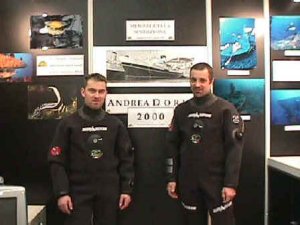
Here I am to tell you about our Adventure, because we really must talk about Adventure with a capital A.
After completing the team's preparations over the weekend of June 16th and 17th, with two dives to the wrecks of the Atlantis and the Vapore, we arranged to meet up on the morning of June 29th at Milan Malpensa Airport.
So at 5:00 AM on the aforementioned day, myself, Roberto Rinaldi, Stefano Ruia, Andrew Fortune, Lorenzo del Veneziano, Luca and Daniele Pallavicini, Jean-Claude Uldry, Laurence Ferrucci, Andrea Ghisotti, and Venceslao Zaina found ourselves at the Sabena (expedition sponsor) Malpensa 2000 Departures Desk with a mountain of luggage to check in. All dressed in the official expedition T-shirts, provided by Acquafredda, we attracted the attention of the other travelers present, and the first questions arose: Who are you? Where are you going? Andrea Doria? Etc.
Our first destination is Brussels, where we'll then fly to New York JFK. The other expedition members, Stephan Havard, Eric Bastard, and Jean Francoise Didelot, will depart from Paris and we'll meet them directly on the boat in Captree.
Take-off as scheduled at 06,40, arrival in Brussels, short stop and then new take-off for New York.
During the flight, the first predictions about what we'll find in and out of the water begin, everyone expresses their opinions, the first jokes and hearty laughter begin, the first photos of the team with the flight crew. Time passes quickly, and the closer we get to arrival, the more the excitement of being so close to our long-awaited destination grows. After the usual endless line through US immigration (it feels like Disney World on peak days), we head to collect our luggage. And here comes the first surprise: none of our luggage has arrived on our flight.
After a useless wait we turn to the Sabena counter, and there we finally meet Joel Silverstein in the company of Lee, a poor copy of Tom Mount.
After a three-hour wait, our luggage finally arrives on the next flight. We exit the airport and arrive at the parking lot, where another surprise begins to raise doubts. A white Hollywood-style limousine, at least 8 meters long, awaits us for the transfer to the boat. We look at each other, a bit surprised and disconcerted, and a question arises spontaneously: Did they take us for Japanese?
Despite its size, the 11 of us in the limousine are crammed together, but despite this, some of us are starting to feel tired from the journey and fall asleep.
A 45-minute journey takes us to Captree, where our boat awaits us. And here's the truly huge surprise. We were expecting, as advertised and based on what we found online, an ocean research vessel, and instead we find ourselves with a 14-meter tourist fishing boat in obscene conditions, to say the least.
We look at each other in amazement as we enter the dinette and cabins. But where are the bathrooms and showers? Here we are, the answer, and the singularity tells us that that little cubbyhole on the deck was the only bathroom/shower on the boat for a total of 24 passengers!!!!!!!!!
Right at the first war meeting, where we review the situation, we decide to take a breather, to try to rest before making a decision. We divide up the seats, and for now, it's going pretty well since we're the only ones on board.
The night passes without any particular problems, thanks to the tiredness accumulated during the journey.
Unfortunately, when I woke up, things hadn't changed. It wasn't a nightmare. The boat hadn't transformed into an Aggressor, but it remained the same piece of junk it was.
A hearty breakfast lifts our spirits a bit. On the deck, the boxes containing the equipment provided by the WHO are waiting for us. We sit on the lawn in front of the dock and begin configuring our gear. From our bags, kindly provided by Cressi Sub, along with regulators, fins, and a mask, emerge the rest of our personal gear. We install the Jaz anatomical snorkels and attach the Riki Star emergency signal (sorry for the commercial break). We exchange ideas on the ideal configuration, adopt new measures, discuss the advisability of standardizing certain elements, and so on. Everyone chooses their own set of tanks, consisting of two double tanks, two Nitrox deco tanks, and one oxygen deco tank. We have steel double tanks of various capacities available, from 12+12 to 18+18 tanks, charged to approximately 270 bar, and steel or aluminum deco tanks of 8/10 liters. While the bibos have 200 or 300 bar DIN connections, the decos are all international. Having started setting up early at 1:10,00, we're practically finished and are waiting, as promised the night before, for someone from the crew to take us to nearby Babylon to catch the train to New York.
At 2 PM, Mangiafuoco (Silverstein's nickname for his size and beard) and the crew are nowhere to be seen. We finally manage to win over one of our supposedly American companions and drive us to a nearby shopping center. Finally, dinner time arrives, and we head to the "Caracalla" restaurant, owned by Vincenzo La Torre, second chef at the time of the Doria's sinking. The restaurant is filled with posters and drawings of the legendary ocean liner, and Vincenzo welcomes us with the utmost cordiality. Here, we meet Bill Hamilton, the renowned underwater physiology expert who has been preparing our dive tables. Dinner is quick and convivial, and we even manage to eat a delicious plate of al dente spaghetti with tomato sauce in the States. At the end of dinner, Jef conducts the usual interviews with Vincenzo and Bill Hamilton. We return to the boat and sleep again.
The 5:00 wake-up call is a bit difficult, and the inadequate breakfast makes things a bit tense. The ship's captain, Janet, a large woman measuring 165 cm tall and weighing 170 kg, takes us to the dive site in about an hour and a half. It's the wreck of the San Diego, an American military vessel sunk by a German submarine. The 170-meter-long wreck lies at a depth of about 40 meters. It's a US national monument, as we're told in the briefing, and officially, touching anything is forbidden. But interrupting Jef's video recording, if we do catch something, the important thing is not to stand out too much. Well done, these Ammerlocks! We're joined by a series of people who are introduced to us in passing; no one knows who they are—perhaps the crew? At this point, there are 24 of us on the boat.
For both dives, we're using the same double-boosters we'll be using on the Doria, but in this case, they're loaded with Nitrox 30. We'll be using these dives to fine-tune the new equipment, configuration, and dive procedures in the water. The deck is a mess, with too much equipment and people preparing at the same time. A slight current, both on the surface and on the bottom, accompanies us during the descent. Visibility isn't exceptional, about 7-8 meters. The wreck is upside down, and the descent line is fixed to the side. The gas reserve (15+15 at 270 bar) and the use of Nitrox allow us to do a first dive of about 60 minutes at the bottom, with a total dive time of close to 100 minutes. There's plenty of fish, including some sizable lobsters. Due to its size, the wreck offers many long penetration routes, allowing us to identify the various areas of the ship. We surface, ravenously hungry, given the scant breakfast, and as we enter the dinette, we smell good food—finally, we're eating. And nooooo….. in fact, we're kindly (????) asked to wait; this is the crew's meal.
When our turn finally arrives, we find only sandwiches and cold cuts, and that's it. To top off our lunch, I manage to find a packet of cookies, which they devour in a flash. Off we go for the second dive. This time, we reduce our bottom time slightly, about 45-50 minutes. Visibility and current remain virtually unchanged, so we continue exploring the wreck and find what must have been the magazine, given the large amount of ammunition present. From the surface, they see a balloon rising, and our companions begin to worry, but are quickly reassured by the crew. Back on the surface, we prepare our equipment for reentry and finally discover what was attached to the balloon. Someone from the crew has dismantled what must have been an electrical panel from the wreck, which is now a pile of rusty scrap metal. How respectful this is for a national monument! Luca, Daniele, Laurence, and Jeff, who remain on the surface, tell us about the embarrassing situations our pseudo-American companions have caused. Open watertights, panic on the surface, closed tanks, running out of air, and so on. And this is supposed to be the pinnacle of Tekkies?????? Back in port, a new war council is called, and we call Mangiafuoco to ask for clarification and demand changes.
After a rather lively discussion, we were offered dinner directly on the boat, given the late hour. Hot dogs, sauerkraut, and all-you-can-eat canned chili. At other times, this menu would have made us sick, but it's true that hunger makes everything taste better.
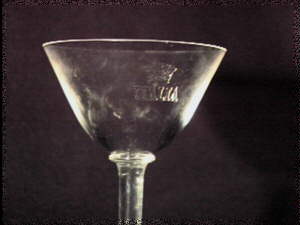
After another fairly peaceful night on board, we disembark. While the boat transfers to Montauk Harbor, our departure point for the Doria, some of us will visit New York, and others will transfer to Montauk by taxi. I'm practically kidnapped by Mangiafuoco, our destination being Captain Bielenda's villa. I realize we've arrived when I see a shiny Wahoo-branded corvette parked in front of one of the villas. Bielenda is a strange character, in his sixties, with an earring and a ponytail; I'd say he's rather slimy, but let's not be fooled by appearances (a big mistake). The lounge we're ushered into is filled with glass cases lining the walls and pieces of wreckage. Inside the cases are a sea of pieces from the Doria and other famous wrecks. Some pieces are truly exceptional, like the Ginori porcelain, the pewter and silver trays, the martini glasses, and the souvenir spoons with the name Andrea Doria painted on them. Precisely on this subject, I'm told that the only things found in the wreck bearing his name are the bell (found by Gary Gentile, who began his career as the Wahoo's tie-in) and these spoons. A painting on the wall shows Bielenda placing a commemorative plaque for the twenty-fifth anniversary of the sinking. Next to the painting is the actual plaque (excuse me, made of wood and bronze). When I ask if it's a replica, I'm told in a disdainful tone, "Of course not, it's the original." And good luck with these Ammerlocks! Do you think our plaque will also become part of the Villa Bielenda memorabilia?
After lunch, we head to the refill center, where the trimix and decompression tanks are being prepared. Left alone with two of the pseudo-chaperones, to pass the time, I fill some tanks, especially mine. Trust is better, not trusting is better, and God only knows, as we'll see later, how right I was. Finally, Mangiafuoco returns to pick me up, and we set off for Montauk. This area of Long Island is a far cry from Captree. Here we see luxury cars and mega-galactic villas, others marinas filled with fabulous yachts.
At least there are bathrooms with showers and hot water here, at least some decent restaurants, and a town just a few minutes away by taxi. Another night on board.
When we wake up, a good, healthy shower and a hearty breakfast lift our spirits. Tonight should be the perfect evening to go on the Doria. We spend the day wandering around Montauk, searching in vain for an internet connection. It seems impossible, but in the land of global communications, we haven't been able to connect, except through a standard telephone with an Italian number, at a telephone exchange clearly run not by Yankees but by Latin Americans.
The complete absence of the captains, crew, and tanks throughout the day made us realize that this might not be a good night, but why, we wonder? We went to the coast guard to check the forecast, and found some very kind and helpful people there, who gave us real-time updates on the weather, which was favorable and normal for this season. Finally, in the evening, some of the tanks arrived, along with Mangiafuoco. When we pressed them about why we weren't leaving, they candidly replied that the weather forecast was bad, and that the news we'd received concerned coastal weather. And NOOOOOOO, we thundered as a group, furious and pissed off. The forecast was coming from the NOAA buoy, which was only five miles from the dive site. Mangiafuoco, with a brazen face, calmly dismissed it, and after unloading the tanks, he left. A new war council, we're truly at the end of our tether, and we're starting to wonder if all this gambling isn't just serving to heighten tension, but to what end? We reluctantly resign ourselves to waiting until the next day to leave, but various plans for retaliation are already taking shape. We fear the amrlocks are preparing some other surprise to keep us from taking us to the Doria. Finally, the cook calls us for dinner, and for the first time, we eat in a manner bordering on decency and in sufficient quantities. I'll leave out the menu list, however, out of respect for those with a weak stomach.
We then decide to call an American friend of Roberto's who works in the travel industry to see if there's anything we can do to break this impasse. When Roberto tells us his story, the person tells us he can't believe his ears, that such things simply can't exist, but unfortunately, we're there to prove otherwise. He finally asks us to send him a copy of the contract, which we promptly do. In any case, the decision is made; a complaint against Mangiafuoco and his team won't stop him.
After dinner, we at least have the chance to go for a walk and have a drink in a pub near the port, to calm our spirits a bit before going to bed, even if calling the bed we sleep in a bed seems really too much.
The next morning we manage to wake up at a decent hour, no doubt thanks to the fatigue caused by the constant stress. But the night wasn't good for everyone. It rained a few drops during the night, and despite everything being closed, it still rained on the bunks in the rear cabin, which Americans rightly call the Dog House. We all immediately head for a shower, taking down payments on showers we won't be able to take for the next three days. Yes, the wonderful Wahoo only carries 1000 liters of water, so showers are off limits for the duration of our stay at sea. Forget Albanians and boat people! The morning is spent sorting out our gear for the trip and analyzing our tanks. And here comes another nasty surprise (not really a surprise, we're expecting something around every corner these days). The mixes are all incorrect; instead of Trimix 17/50, we find 22% O2, and who knows how much helium it contains? Of course, 22% to descend to 70 meters is truly reckless. To the soul of the Americans' preparation and safety.
We decide to go to lunch at a nearby pub so we can discuss the coming days' plans in peace. It's clear that Mangiafuoco and his gang are doing everything they can to stress us out, undoubtedly with the goal of ruining our dives, or even preventing us from doing them altogether. We therefore unanimously decide to dedicate all our dives to achieving our objectives: photos, videos, and placing the plaque. This clearly means we'll have to use our bottom time not so much for free exploration of the wreck, but rather for specific roles. Everyone is asked if they're willing to sacrifice most of their dive, and the positive response is unanimous. We've set out for this, and we want to achieve our goal. I must say that such a unanimous response moved me a little; the difficulties we've encountered so far have strengthened the group's unity rather than destroying it. In the afternoon, the dinghy we'd requested from Mangiafuoco for safety arrives, along with the last of the equipment. 3,30 meters long, in pitiful condition, full of cracks and patches, with a tiny 4-horsepower motor. And they think they can use it in the middle of the ocean in an emergency? Aren't they ashamed? The more days pass, the more I realize they speak and write well (or almost), but in reality they're just quacks.
In the afternoon, Luca and Daniele went trolling, returning with two large catches. Thank goodness, as this fish will be our dinner that evening before we leave. Stefano rightly calls us to order. Caught up in all these problems, we forgot to prepare the dive tables, deriving them from those provided by Hamilton. These tables are interesting from an operational standpoint, as they allow the use of Trimix bottom mixes with percentages of helium from 20 to 50% and oxygen from 17 to 20%. Two decompression mixes are provided, one transferring from 35 to 50% oxygen and the other from 85 to 100%. These variables make these tables particularly suitable for use during expeditions. Repetitive dives are also simple: just leave a three-hour interval between the two dives and use the table with the correct depth but the time 5 minutes longer than the actual time. Group photo with all the uniform and we are called by the legendary (????) Capt. Steve Bielenda for the briefing.
Dachshund, bald with a tiny white ponytail, tanned, plump, and a bit slimy, he really doesn't look like an experienced technical diver. I introduce the team to Joe Codino, so he realizes he's not dealing with the usual group of inexperienced divers, but a group of professionals with years of experience behind them. A little impressed by their CVs, the Captain begins his briefing with theatrical emphasis: "Careful, careful, careful, diving is a dangerous sport. You'll be lost in the middle of the ocean with very strong currents... How strong does one of us ask for? Sometimes even half a knot!!!!!! "Half a knot," we say, "but he's joking," we say, incredulous. Since the scene hasn't worked, he tries to make up for it with: "But it happens that it reaches 1 knot," another incredulous look from us, and even a knot and a half!!!! We stop before a ten-knot current arrives. Having failed to impress us, he then plays the masterstroke. Taking a white envelope, he begins to examine its contents with a tragic expression, until he takes a photo and, with grave words, passes it for all to see. This diver died a few years ago!!!!! He had violated the dive plan and entered the Doria. It took four dives to free him. In the photo, the corpse of a man wearing a still-wet dry suit, with something, perhaps blood, coming out of his mouth. Shocked, not by the photo, but by the disrespect and crudeness of the gesture, we looked at each other in silence, until Roberto, to defuse the situation, blurted out, "But won't you show us the others?" I'll skip the rest of the briefing, also because he basically said absolutely nothing useful. No real information on safety, on the rules of conduct in the event of an accident, or anything else. But...
Finally, it's time for departure, but first I'm called back by Mangiafuoco and Joe Codino for a meeting in the control room. I think it's some final instructions, but I'm wrong. They tell me there are extras to pay for the trip. Specifically, a supplement for food (according to them, they've never seen people eat so much!!!!!! How come we starved for three days) and for the difference in fuel price. Surprised, I ask for clarification, especially about the food. Is it possible that we eat more than Americans, considering we're half the size (in width)? The answer knocks me out: "Your metabolism is twice as fast." It's true, they have faces like butts.
I consult the others, and together we decide not to give him a penny. But will they let us leave??????
Luckily, the boat casts off and we venture out to sea; perhaps this really is the right time. The sun is setting, the sea is calm, the company is good; what more could we ask for? Perhaps better food, or greater expertise from our guides, but for this occasion we'll settle for less, since we almost gave up hope. The evening on board passes quickly, everyone imagining what will happen the next day, what we'll see, what the dive will be like, etc. On the GPS chartplotter with electronic charts, kindly provided by C-MAP, we check the distance between Montauk and the Doria. Indeed, it's over 100 nautical miles from the nearest coast. To get to bed and sleep, we're forced to wear earplugs, given the incredible noise the engine makes inside the cabins.
We wake up in the morning, just as we hear the engine slowing down. We all dart out at almost the same time. Outside, a foggy sky greets us, but the sea is calm and visibility on the surface seems good. Perhaps the wheel of fortune has lost our bearings? Immediately, Capt. Hank and Lee prepare to attach the descent line to the wreck. As usual, the tools of the trade of technical divers expert in Ammerlock wrecks hang from their belts: a metal mallet, chisel, shears, and a crowbar. Strangely, however, I've never found them listed among the equipment required for this type of dive in any manual, even the American ones. From the moment we enter the water, about two hours pass before the divers return to the surface. We anxiously ask for information on the situation at depth. As always, we're asked to wait; they must first reunite with the rest of the crew. Mangiafuoco has re-entered the crowded boat; he doesn't say anything to us, but runs to the bow. After a few minutes, we go to check it out and find him breathing oxygen. What happened? Very hard dive!!! Could it be that crazy, strong current on the bottom we've always been told about? We check his bi-reef, and it's practically empty. He sucked in an 18+18 bi-reef charged to 270 bar for 15-20 minutes of bottom time!!! But...
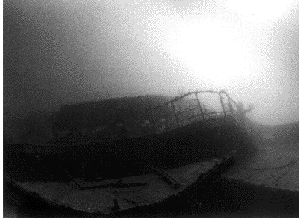
We finally get the OK!! The first three divers get ready, then it's Roberto, Stefano, and Pechy's turn. Once in the water, they confirm there's only a light current. Then four more divers follow, and finally it's my turn.
Once in the water, we begin to descend onto the ropes, which aren't pulled well from the surface and are steeply inclined, increasing the time and effort required for the descent. As we descend, the water becomes increasingly less clear and takes on a strange greenish hue. And then we begin to glimpse the wreck; the thrill is overwhelming, even if for the moment we can't quite figure out where we've arrived. These sensations at least partially compensate us for the ups and downs of the past few days. And there we go. We begin our exploration and soon reach the promenade deck. Most of the window glass is gone, but the structures and especially the teak floor are still in excellent condition. Grayish-white anemones almost completely cover the wreck, as if it were covered in soft snow. The spaces are enormous, and we manage to make penetrations without having to remove our tanks from our sides. We're around 67 meters deep, and being in Trimix (I'm not sure how much helium there actually is, but there's definitely a certain amount, given the duckling effect on the voice) gives us maximum clarity in observing all the details. Incidentally, there's no trace of the deep current of death they told us about. Are we lucky, or are they just lying, covering up their physical unpreparedness and technical expertise with these excuses?
As always when you do something you enjoy, time flies by—30 minutes seems like a moment, and Hamilton's tables are practical but require very long decompressions. The ascent goes smoothly, down to six meters, where a tangle of lines, hoses, hookahs, and other things has formed a spider's web. Will we little ants manage to escape this trap? The hookah oxygen regulators, which should normally be on the line for safety, are located amidships, under the keel, unusable. Luckily, none of us had any problems. Back on the boat, the stories of the different groups intersect, words flow freely, reflecting the emotions we felt on the bottom. We're already talking about what we'll do on the second dive.
But for the next dive, they'd normally have to partially refill the tanks. Instead, no one on the crew moves, and the compressor is covered by a tarp. After several attempts, they finally decide to start refilling, almost surprised and bored that we're going on a second dive. We immediately realize they don't have helium on board and that they're only refilling the tanks with air. According to the H tables, this might be possible if the mix is 50% helium and the dive uses a maximum of 60%. Refilling to 100%, in this case, would leave us with 20% helium, which would be within the limits. But if someone uses more, isn't he entitled to the next dive? And when do they tell us this? Maybe they're used to Ammerlock divers, like the ones we've seen on board these days, who are happy if they manage to do a dive. Finally, they start refilling, and bang, one of the high-pressure hoses bursts. Maybe they haven't used it in years? We manage to change the hose, but by then time has passed and the small 12M3 compressor certainly won't be able to refill all the tanks in time for the second dive. So we decide to use some of the tanks scheduled for the next day. We eat a frugal meal, so as not to weigh ourselves down, and then we set off again for the second dive.
This time, the current is stronger and follows us all the way to the depths. Visibility is significantly lower than this morning, and the greenery is darker. I'm paired with Andrea; he takes photos and I shoot video. When we reach twenty meters, I ask Andrea, who's ahead of me, where he's put his camera, which I can't see. Andrea anxiously looks around, but to no avail. Unsure of the camera's fate, we decide to continue descending. Once we reach the bottom, we immediately set off to explore the promenade deck and the adjacent lounges. Andrea, though anxious about the RS, does his part like a true professional, lingering at the windows of one of the lounges, perhaps the dining room, where the glass is still in excellent condition. After a quick clean of sediment, it's possible to see inside. We move on, arriving at what must have been one of the cranes used to lower the lifeboats into the sea. Andrea and I exchange glances, tempted to go further, but the thought of not finding the line and having to decompress in a current doesn't appeal at all. If that were to happen, given the people and equipment ensuring our safety, who knows if we'd be able to be rescued? The boat is attached to the descent line with the divers on deco, and the dinghy is practically sinking, so deflated and full of holes that let water in. We continue exploring that area and are already beginning to orient ourselves on the wreck and understand where we are. The minutes pass and we begin the ascent at the 25th actual minute, but as previously explained, the HR tables recommend using the 30-minute decompression plan. This time, the ascent is less comfortable; the current and the fatigue that is starting to take its toll make the minutes seem interminable. At 6 meters, the same mess of ropes, whips, etc., forces us to be careful not to get stuck. During the final stages, we receive a visit from Jef, who is filming the decompression stages for his documentary.
Back on board, we immediately check the quality of the footage Pechy and I shot. Each of us sees a portion of our own dive, and comments pour in like a river: "I was there," "there's an entrance a little to the right," "my lamp got stuck right there," etc., reliving the same emotions for a few moments. We're extremely tired and worn out, not just from the dives but from all the vicissitudes we've experienced, and having managed to reach part of the finish line eases the tension, and the fatigue hits us like a glove. We double-check the dive profiles on the computers, and considering we've done two Trimix dives just three hours apart, with fairly long dives, in less than optimal conditions, without encountering the slightest problem, it makes us appreciate Hamilton's tables.
The evening is beautiful, the wind has died down, and the sea is as calm as glass. The setting sun is starting to cast a reddish hue on the sky, and to top it all off, we receive some visitors. "A fin... there, right in front of us," immediately followed by "sharks, sharks." But what sharks? It's the dorsal fin of an enormous sunfish swimming just a few meters from the boat. "Look... the dolphins," "Yes, they're over there," "They're over there too." In short, for two hours we didn't know where to look; we were surrounded by sunfish, dolphins, and pilot whales. Finally, they call us for dinner. An Italian dinner in your honor, it's announced. Frozen baked pasta, with two types of sauce that otherwise would have disgusted us, overcooked pasta, all reheated in a clean oven, perhaps in 1900. If they call this Italian cuisine, good God. But we're very hungry, and there's always little food, so we make the most of having plenty of warm food; given the situation, it's best to stock up.
After dinner, with our bellies finally full, we make plans for the next day. Given the calm, we decide that the different groups should head in different directions to explore the wreck as much as possible. We also need to think about the plaque, which we need to attach to the wreck. The initial idea of placing it on the bridge, near Vailati and Carletti's, was thwarted when the three uppermost bridges, including the bridge, collapsed and fell downward. We'll therefore attach it in an inconspicuous spot, so that it will remain in place as long as possible before becoming a collector's item in some ammerlock's display case. Stefano volunteers to descend with a vertical line beneath the boat, to try and recover Andrea's Nikonos RS. Someone suggests we toast the first dives on the Doria, but for now we prefer not to celebrate too much; with these slobs, you never know.
At dawn the next day, we're awakened by the sound of the engine. We literally leap out of bed to see what's happening. A light wind has picked up, the sea is choppy, and we're sailing through fog. Stephan was essentially awakened by water dripping onto his bed from the various holes in the Dog House's ceiling, and he discovered that while everyone was sleeping peacefully, the boat had left its mooring and was drifting peacefully. We immediately check the GPS, and we're practically 10 miles from where we were the day before. And where the hell were the four captains who were supposed to be shifting around the clock? Is it possible that everything on this boat is left to improvisation? Maybe it's all organized so they can recover the lost car?
We reach the dive site again, and Hank and Pete descend to re-secure the anchor. This time they bring with them the necessary dive gear, "crowbar and mallet"—who knows what their intentions are? Meanwhile, we have breakfast, this time a very large one, although of poor quality, as always.
Two hours pass and the two divers climb back on board, their faces drawn. Without saying anything, they go to the bow with the rest of the crew and chat for at least twenty minutes. Finally, Joel decides to speak: the anchor is caught in a net, in an unspecified part of the wreck (they haven't been able to orient themselves), impossible to move, poor visibility, and current. "Let's cut the line and put on another," Roberto immediately says. "No, impossible, this is the last anchor left, after losing the other one during the night. So if we lose this anchor too, goodbye diving!"
Finally, Rick and Lee decide to disembark to try to secure a cable from the anchor to the wreck. Another two hours of waiting...
Meanwhile, we try to recover the various tanks that, perhaps equipped with legs, have moved or even disappeared during the night. Having managed to reassemble everything as best we could, we begin to get dressed.
Rick and Lee come back up, still with dark faces, scowling as they say in my parts, and always the same old story, meeting at the bow ………
Finally, Joel: we're clinging to the gunwale of the wreck; but it's highly unstable and could collapse at any moment. Exceptionally, since you have to deposit the license plate, you choose three of your best divers, who will be the only ones allowed to dive. This time, we're the ones conspiring, and the answer is blunt: CUCCURUCÙ, you have to stop bothering us here and we'll all dive in, otherwise we'll end up creating another wreck with the Whaoo!
Seeing our determined demeanor, he agrees, but to allow this, he'll sacrifice himself and put on a new line, descending before us. He gets ready, jumps into the water, and... Help, the zipper on the drysuit is open. Back on the boat and finally successfully jumps into the water again. Shortly after, a balloon appears a few meters from the vessel. The crew looks at each other in panic. What are we going to do? So Rick undresses and, without fins or anything else, jumps into the water, reaches the balloon, but drifts too. Luckily, after a couple of missed throws, they manage to get him a line and he can climb back on board. Attached to the balloon is a porthole torn from the bottom, still with fresh saw marks on the bolts. They proudly display their prize. What do you think? We, more than the porthole, are shocked by the thought of what would happen if one of us were to lose the ascent line, launch the balloon to ascend, and decompress in the current. Where would it end up??? Definitely in the poop!!!!
Finally, after a good six hours since the first divers arrived, Roberto (camera), Lorenzo, and Andrew (plate) set off for the dive. We followed the cable indicated to us by the crew, which was the best way to reach the bottom.
The current is weak, visibility fair; who knows, maybe it will change as we descend. Meanwhile, the line is increasingly parallel to the bottom, practically starting to rise in the final stretch. After a good six minutes of descent, we finally reach the wreck. Here too, conditions are excellent, better than the previous day. A short distance away, we see another line rising; this one is much more vertical and firmly attached to the wreck; no trace of nets or anything else, demonstrating the crew's bad faith. We secure the plaque on the bottom with a handshake between Andrew and Lorenzo, and set off to explore. The good visibility allows us to appreciate the impressive size of the wreck. We are in the bow section, where the bridge once stood. The lifeboat davits now appear to us in their true grandeur, and they are enormous. The rooms we glimpse through the doors invite us to enter; we look each other in the eye, saying, "Let's go, let's not go..."
Then common sense makes us reconsider what happened on the surface, and we give up, continuing our exploration from the outside, always keeping an eye on the way back. While I'm staying behind to catch up with the group, the regulator becomes hard. I check the pressure gauge: 240 bar. What's happening? I quickly change the regulator, taking great care not to let go of Uldry's camera, and fortunately I manage to breathe. With my hand behind my head, I try to open the manifold valve and hear the classic siphoning noise. Yet I had checked everything before putting on my gear. Could it be that some Ammerlock man had tampered with it while helping me? They don't do anything, and once they do something, it's the wrong thing. I call the end of the dive and we head back towards the summit, which we find without any problems and begin the ascent, first stopping at 45 meters, then the others, and we exit about two hours after entering.
On board, Andrea is impatiently waiting for Roberto to lend him an arm for the flash. He'd managed to set up the other camera during the morning, and he doesn't want to miss this last opportunity to take photos of the Doria.
The second group includes Andrea, Peky, Stephan and Eric.
Upon their return, after about two hours, they tell us about their experiences. Andrea and Erica followed a line that ended at twenty meters with a lead. Returning, they choose another line (there's a veritable tangle of lines under the boat) and finally find the right one. Arriving at the wreck, they encounter strong currents and poor visibility (what a change in two hours) and manage to take only a few photos. Pechy and Stephan are luckier; they descend to the good line and film the entire dive. During the ascent, at the 15-meter mark, the current suddenly ceases, greatly facilitating the divers' journey.
We're all exhausted, the fatigue of diving, sleeping and eating little and poorly, and the general stress are starting to take their toll.
We're still satisfied that we've succeeded despite all the adversities we've faced. So the celebrations begin, with champagne toasts. Jeff comes out with one of his favorites: if stupidity could fly, these Ammerlocks would have been in orbit long ago. Who knows, maybe that's why it's the astronaut country par excellence. Alcohol gives us the final blow, and soon we're all back in our cubicles.
This concludes the tale of the expedition, at times tragic, at others delightful. We certainly achieved our goals—diving on the Doria, depositing the plaque, taking photos and videos—but what gave me the most satisfaction was the exceptional teamwork, even in the face of the most challenging situations. I hope this expedition is just the beginning of a series of future endeavors.
Reproduction of the text and photos in this article, even partial, is strictly prohibited without the author's consent.