



It's also time to talk about travel! A passion for the sea and its creatures is a great excuse to travel... While snorkeling can be enjoyed close to home, in the sea we've always been accustomed to, there are places whose geographic location, water characteristics, and so on certainly offer unique experiences.
Since I worked in the Maldives for many years on cruise ships, I'd like to start talking about travel right here, because it's obviously easier for me.
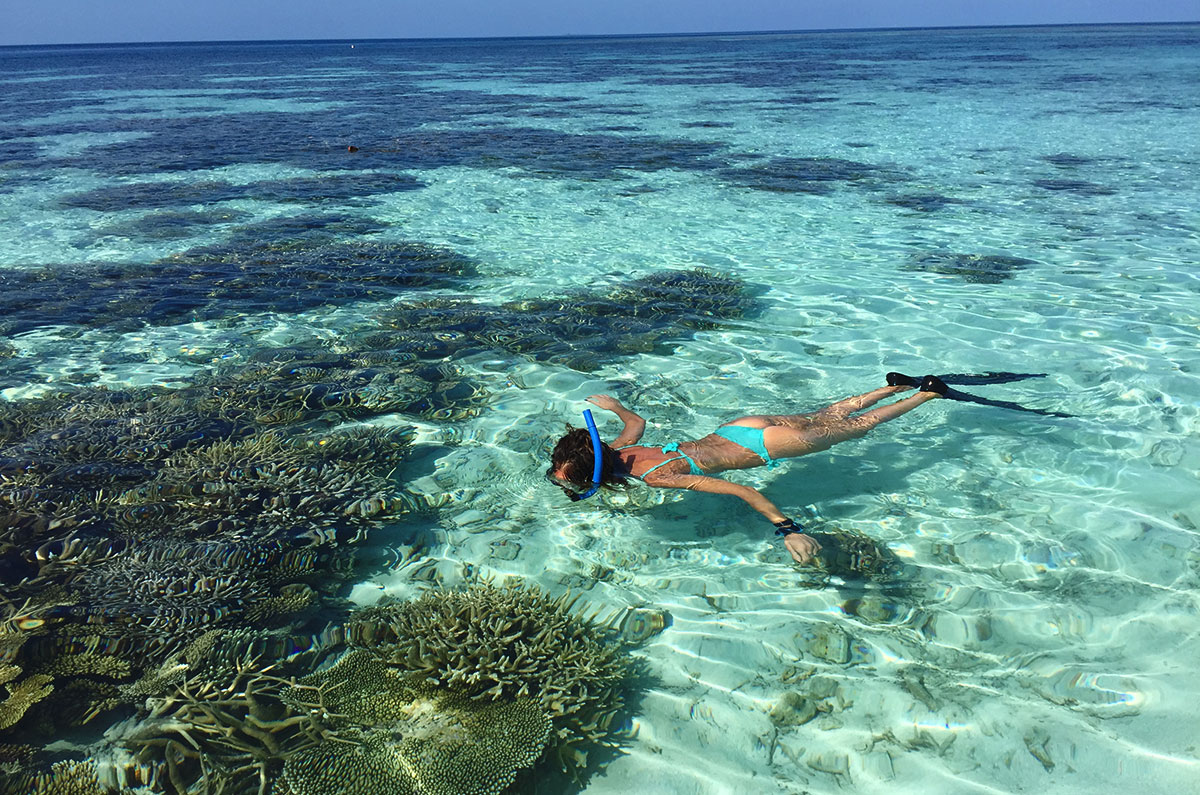
While the Maldives' seabed is undoubtedly among the most beautiful in the world, so too are the small islands nestled in this turquoise sea . The transparent waters lap at pure white beaches of coral sand , fringed by coconut palms and mangroves.
The Maldives are a heavenly holiday destination for anyone seeking contact with the sea , the ever-changing discovery of nature, relaxation, rest and why not... a tan!
The Maldivian archipelago consists of more than 1200 islands and islets grouped into atolls. An atoll typically consists of an outer (or oceanic) reef , an inner lagoon, and many islands scattered here and there like a myriad of emerald shards. Each island is then surrounded by its own lagoon and protected by its own reef.
On the reef, the water has created channels called passes in the most fragile areas. These passes are used by boats to enter and exit the atolls, but also by water driven by currents and wind, and, of course, by all marine creatures as they move throughout the Maldives.
Not all animals move and migrate, many remain tied to the reef for their entire life or for part of it and never leave it. Among these are the majority of the colorful reef fish.
Inside the lagoons, in very shallow water, live mainly small fish and young that are not yet ready to face the sea (such as blacktip shark pups, many rays, etc.). Every now and then, predators (jackfish, tuna, etc.) arrive here too, and then clouds of fry take flight, trying to escape them...
The island's reef is home to reef fish that feed on the coral or find protection within it. There are also turtles , rays, and a few small reef sharks . When the island is close enough or in the direction of a pass, larger fish like manta rays also arrive.
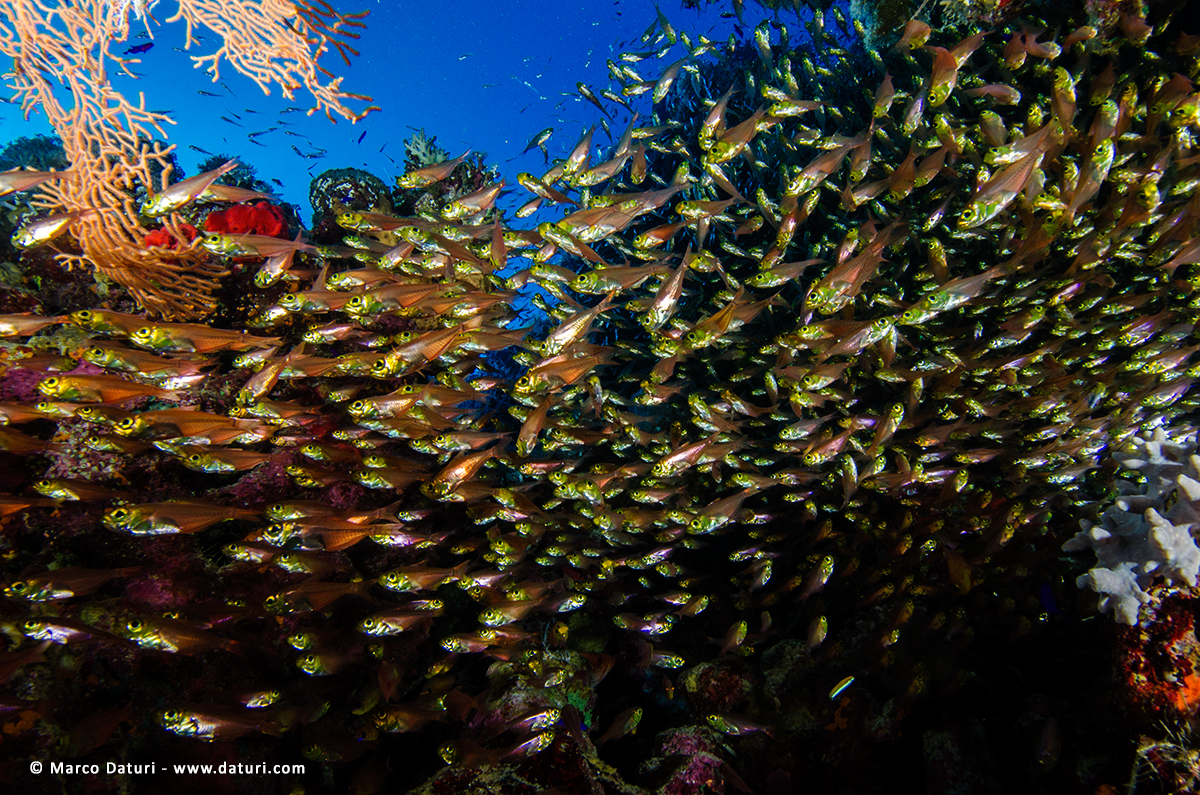
Snorkeling in the lagoons allows you to spot numerous juveniles, often with brightly colored colors different from their parents, as well as numerous mollusks (some of which are large) living on the sand, and observe fascinating hunting scenes. As you venture out onto the reef, the sea becomes bluer and the fish more colorful. Here, hard corals and madrepores dominate , along with the myriads of small fish that live among their branches, the turtles that feed on them, and the splendid schools of fusiliers darting across the blue. Then there are the reef fish's predators: jacks, tuna, and even larger fish.
The atoll's outer reef, however, is sparser in coral (due to the more aggressive action of the sea and currents). On the outer drop, the sea is bluer, a bright blue where the bottom is invisible and there's plenty of room for imagination. This is where the largest fish live. Snorkeling on the ocean drop offers a taste of adventure, discovery, and the allure of the unknown. You'll swim among schools of silvery-gray fish, and every now and then a large Napoleon wrasse appears. Turtles stand out against the reef, and the variety of fish you encounter is truly incredible. In these areas, you'll likely encounter giant manta rays , feeding on plankton and performing their elegant loops; whale sharks, with their enormous size and slow, lazy pace; nurse sharks resting under mushroom coral; rays and stingrays moving swiftly over the reef; eagle rays entering and leaving the atoll; and who knows... every day is a new thrill and a new adventure.
Snorkeling is one of the most popular activities in the Maldives . It's accessible to anyone who wants to see the most beautiful part of this archipelago: what lies beneath the sea's surface!
The water temperature is constant year-round, ranging between 27°C and 29°C, making it very comfortable even for long snorkels. The water is clear and transparent , and the sea conditions are among the calmest of all. The outside temperature, around 30°C, is never too hot, making it very pleasant to bask in the sun and let the rays dry you. In short, ideal conditions for snorkeling!
On board our boats, an expert guide with many years of experience accompanies us on two daily snorkeling trips to the most beautiful sites in the Maldives. In addition to ensuring the group's safety, the guide answers snorkelers' questions and concerns.
Snorkeling can be done directly from the dhony (support boat) on the outer reefs and passes, or from the beach in the lagoons and reefs of the islands, or even from a tender. When snorkeling is offered far from the islands, there is always a support boat nearby so everyone can decide if and when to stop or resurface if necessary. The guide always carries a marker buoy, and snorkeling jackets are available on board for those who feel unsure, and wetsuits for those who are sensitive to the cold (which are also very useful for providing additional buoyancy).