



A trip to California, an old suitcase, and the most beautiful ship in the world.
I've decided to combine these three elements to tell you a story. Today I'll take you underwater, into an inner reality, at least in your imagination. Ready to join me? Taking us down there, into the depths, will be one of the world's leading Italian underwater explorers and documentary filmmakers: Andrea Murdock Alpini.
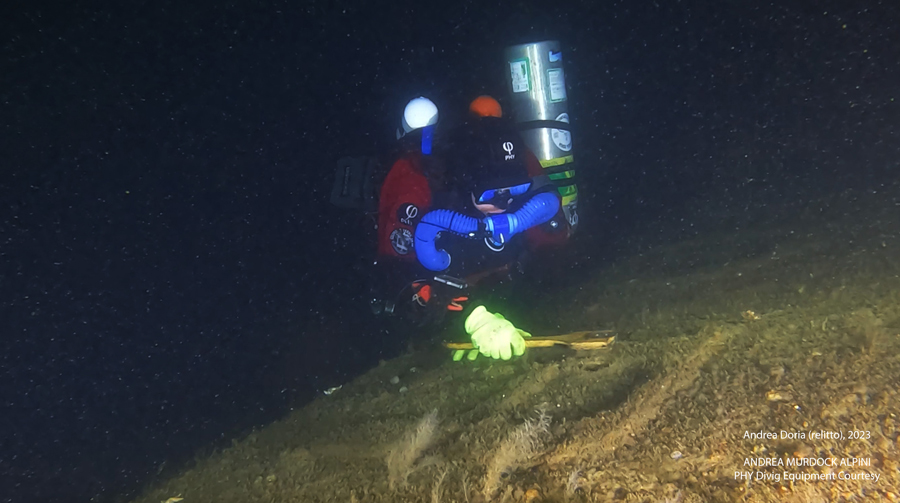
On the Atlantic Ocean floor off Nantucket, where the water is often murky and the currents are rarely gentle, someone is filming a spectacle: the remains of the Andrea Doria, the flagship of the Italian Navy, which sank in July 1956. Andrea is leading the diving expedition that is now featured in the Focus documentary, Andrea Doria: The Wall of Silence. Of the beautiful Italian ship, he says: “Some myths never die”, while evocative images he's filmed of the wreck scroll in the background. Suddenly, he's moved and doesn't hide it.
It completely captures my attention. I'm fascinated, intrigued.
Years ago, I was in California.
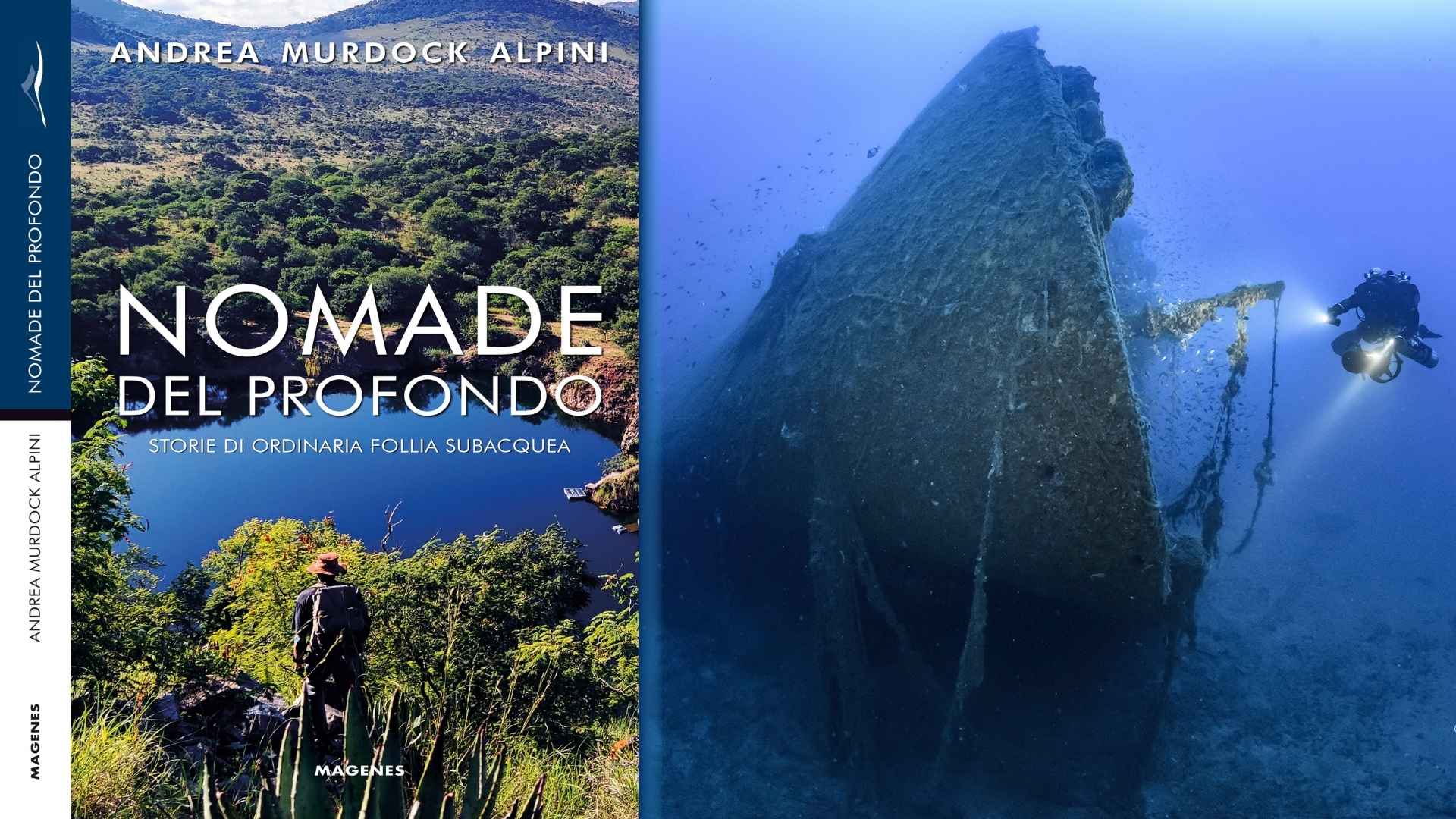
I had traveled to meet two remarkable people, survivors of the shipwreck. There, in the sunniest land in America, I began to develop a fascination with the ship and to conduct research. But I had never considered the wreck. What effect does it have on those who observe and study it today? It would be interesting to talk to someone who has truly cherished that myth. I decide to write to Andrea; I want to know more. I discover that he writes books and publishes articles for Italian and foreign publications, where he recounts and shares his adventures and experiences. Like me, he has a soft spot for Hemingway, but especially for Bukowski. During the interview, he tells me that his latest book will be published in a few days: Nomad of the Deep: Stories of Ordinary Underwater Madness(the subtitle is inspired by the famous work of the irreverent writer).
Andrea is humble and kind, and I reveal my curiosity, now not just about Andrea Doria, but about the character. He is open to guiding me into his world, the hidden one.
"Contemplation and silence precede the moment before the somersault into the water. From life on land, you suddenly transition to life in the water. Being on board represents the most beautiful moment, before starting the dive."
How many other places in the world have you dived in?
"The Barents Sea, the Strait of Sicily, the Baltic Sea, the Åland and Orkney Islands; in the flooded mines of South Africa and Europe and in the depths of caves in Russia, Slovenia, and Romania, but also in Ireland, in the strong currents of the Strait of Messina, and in many other seas around the world ." I then think of how many stories he still has to tell.
After graduating in Architecture, he founded two contemporary art galleries, but the call of the sea and wild nature were so strong that they convinced Andrea to reclaim the life he dreamed of as a child.
It's the summer of '90.
Andrea was only five years old when he tried to breathe underwater for the first time on the Island of Elba. Beside him was his father, his superhero, a passionate scuba diver. His words, even today, convey the joy of a child who savored that moment as an adventure. At ten, he took his first dive, and at sixteen, he began his endless career exploring shipwrecks.
As a bookworm, I asked Andrea to tell me about his latest work, Nomade del profondo: storie di ordinaria follia subacquea , which will be published in a few days.
Interview with Andrea Murdock Alpini, underwater explorer and author
Who are the deep nomads?
«It is those who arrive at the inner clarity of things, who reach the essential».
What is depth for you?
"Numbers age very quickly, emotions don't. Inner depth doesn't involve competition, but harmony between yourself, your techniques, and the environment. For me, the goal is never a number. My goals are knowledge, what happens while I'm there, what I feel, and, above all, what I can convey."
Through this inner depth, Andrea leads the reader around the world, allowing them to journey with their minds and emotions. Page after page, we journey to places he actually visited, reliving and giving voice to distant stories, passed down through time. I let his words enchant me. Even sitting at my desk, it's as if I'm somewhere else.
The book is divided into three sections
The first part It's dedicated to ancestral journeys, first descending underground and then underwater. From deep caves in the Romanian Carpathians to a flooded mine in South Africa, it reaches the peaks of the Eastern Alps to immerse itself in secluded mountain lakes.
What does it mean and what does it feel like to know that the mountain is above your head?
Just the thought sends a shiver down my spine.
The second part The book is dedicated to three interviews with the American oaks, as he calls them, or rather the pioneers of technical diving who revolutionized the way we think about diving.
Three stories with a salty flavour conclude this inner journey.
We cross Europe from northern Norway to the deep south of Greek Calabria. Here Andrea dives into the Barents Sea and retraces the epic tale of the great navigator Willem Barents.
«Over four hundred years ago, the Dutch explorer set out from continental Europe to reach the North Pole and begin charting a route that would allow him to find a hypothetical Northeast Passage.
For me, diving into its sea was the pretext to recount the grandeur of his exploration, of a man who, despite very few tools at his disposal, sought the depths and vastness of the white continent. It will be the wrecks and the meaning of the journey, in this final part, that will bring us home.
How can a wreck bring us back to ourselves?
"True wrecks are alive, like people; they demand distance and time. You must connect with a wreck to understand its shapes and spaces. It's the wreck that allows you to do so, not you! By following its lead, you'll be better able to understand yourself and manage your emotions. When you're too focused on the goal, you're willing to do anything, and that can alter your perception of the world around you."
For Andrea another beautiful moment is just after the ascent:
"When you return to the surface, especially after seeing something new, it's exciting. You float and see the curiosity in the eyes of the people on board."
It must be exciting, I think, but I can't fully understand how a wreck can be called alive. Talking to him, however, makes everything clearer. Sometimes, there's probably much more life and soul down there than there is on the surface.
It changes shape and appearance. It degrades over time and is inhabited by life forms. It becomes a cultural and archaeological heritage. Sometimes even a cemetery.
Can you fall in love with a wreck?
This reminds me of another of his books, Andrea Doria. Un lembro di patria , which I'm reading at the moment.
"The time has come for my dance around the Renaissance propeller of the Andrea Doria to end," he writes in his book Andrea Doria. A Strip of Homeland. "It takes two for miracles to happen on the wreck. […] And so, before turning my back on the Turbonave's propeller, I removed the regulator from my mouth and placed my lips on the first blade I came across. A long goodbye."
Time is running out and he will be leaving for Norway again in a few days, but we promised each other that upon his return he will tell me about his winter adventure among fjords and wrecks of the Second World War.
But I have one last question.
If you had to give a title to that kiss, what would it be?
«HIC ET NUNC, here and now.
You can fall in love with wrecks, but you also have to know when it's time to say goodbye to them."
A title for him.
For us, perhaps, a precious piece of advice.
Thanks Andrea.