



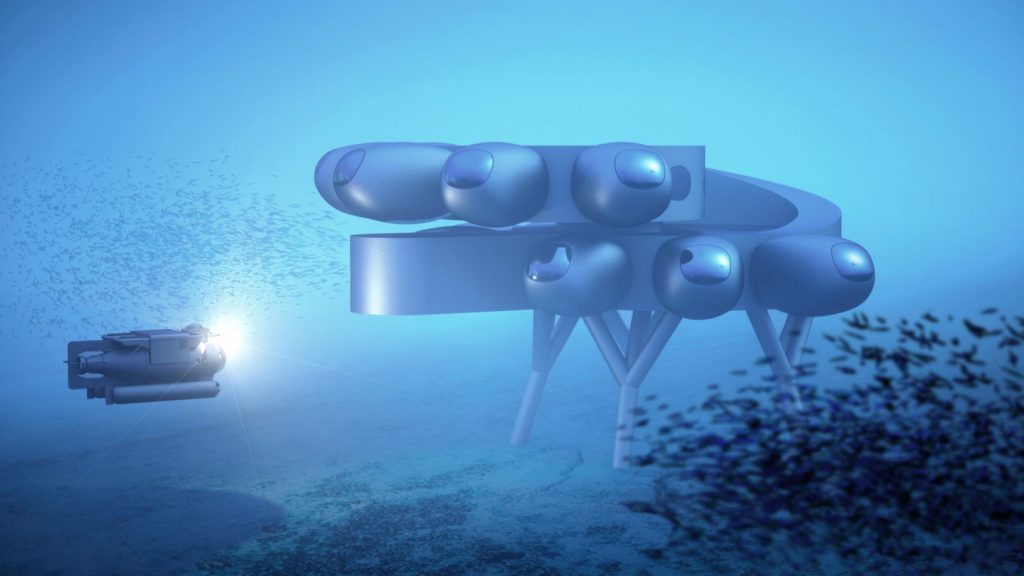
Proteus, a research laboratory at a depth of 20 meters. It might not seem like much to us divers, but imagine living there for weeks or months.
Fabien Cousteau, Jacques's grandson, designed an underwater research laboratory, called Proteus, modeled after a real International Space Station, to be located in the waters of Curaçao. This unprecedented project would host researchers from around the world to study the oceans. The laboratory, four times larger than any current solution, would revolutionize marine research.
The estimated price? $135 million.
The idea is for researchers to work immersed in the object they study, obtaining firsthand data, unaffected by surfacing and changes in pressure, which are inevitable when considering an oceanographic vessel or a traditional laboratory. Furthermore, departing and returning to a station submerged at 20 meters eliminates the need to decompress after each dive. In short, according to Cousteau, scientists would be able to complete 30 to 40 times the research work they could do in a traditional laboratory in the same amount of time.
The project began 2 years ago with a meeting with Yves Béhar's design studio, Fuseproject , and you can see the result here.
Proteus research laboratory
The project is extremely ambitious, about 10 times larger than the only active underwater laboratory, Aquarius , used by NASA, which Fabien Cousteau himself, after spending 31 days there in 2014, described as a kind of school bus. Unlike Aquarius, Proteus is designed to be inhabited for extended periods of weeks or months. Two spiraling cylinders, constructed from shipboard metal, extend across two levels connected by a ramp that allows scientists to live, walk, and exercise without undergoing significant changes in pressure.
It's possible to envision expansions outward from the main structure, which will house laboratories, a greenhouse, visitor rooms, and a doctor's office. Round windows maximize the passage of light, allowing visitors to maintain a day-night rhythm even in dim lighting. This may seem like an exaggeration, but in reality, people need these little comforts to live underwater for extended periods. For example, they burn three times as many calories in the same amount of time as they do on the surface, so scientists will need to eat a lot, and the station will need to produce food and enable them to cook it without flames. These are all things that need to be taken into account in the design phase.
For now, Proteus is a project, a dream, in the process of raising the necessary funds to make it a reality. In this slideshow, we see how the lab would be structured.
Images are © Fuseproject