





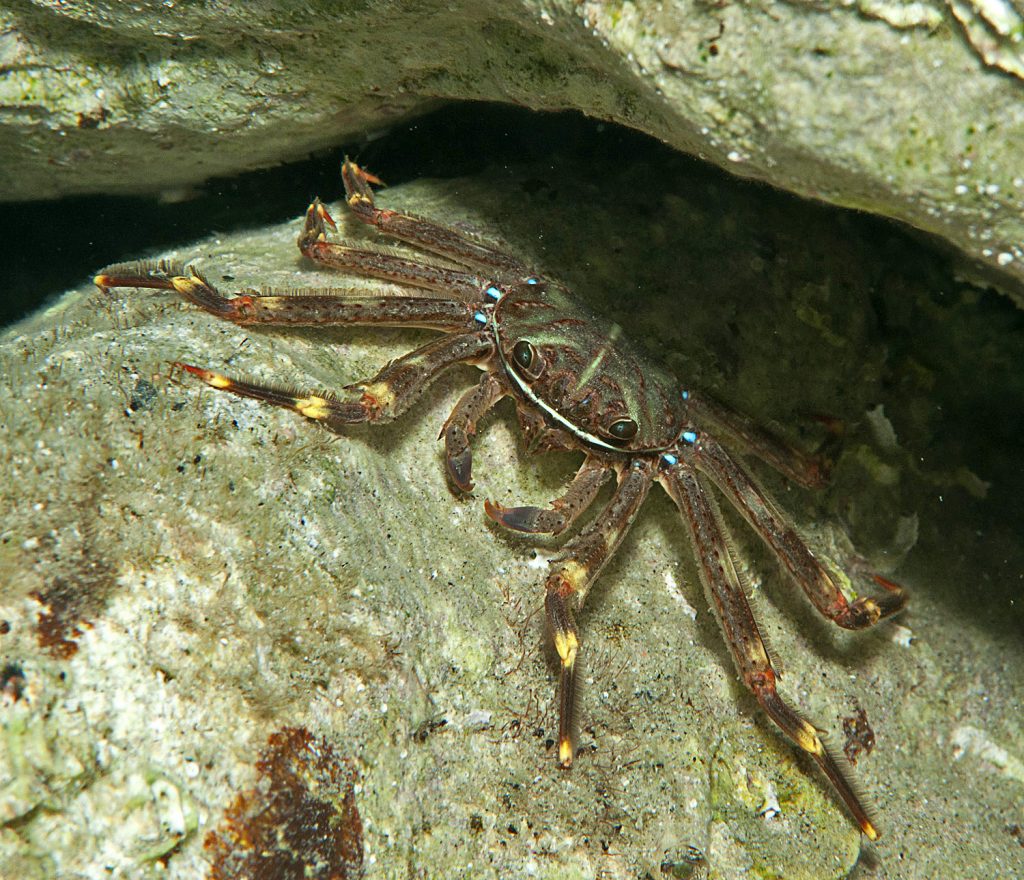
- Name: Percnon gibbesi (Atlantic racer crab)
- Class: Crustaceans
- Order decapods
- First report in the Mediterranean: 2000, Linosa
- Origin: Tropical Atlantic, through Gibraltar.

Percnon gibbesi is a medium-sized crab native to the shallow coastal waters of the western Atlantic, from Florida to Brazil. It was first recorded in the waters of Linosa in 2000. Since then, it has spread rapidly up the Tyrrhenian coasts of Italy. At the same time, a series of reports in distant locations suggests it was transported by ships.
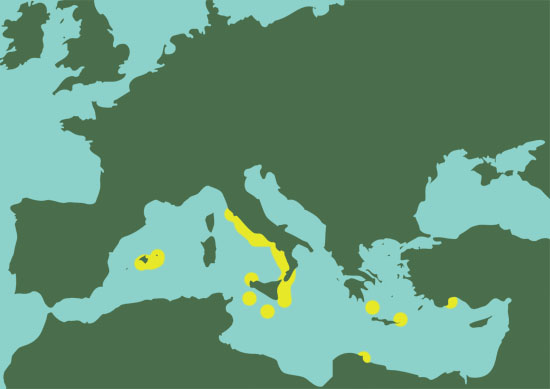
A side note: Ballast water, the water pumped into the holds of empty cargo ships, was likely exploited by many of these animals moving from one area to another. In their larval, planktonic stage, they could easily be sucked up here and deposited there, and voilà: they unknowingly crossed the oceans.
How to identify the Percnon gibbesi
Identification : Carapace width 4 cm, with legs extended it can reach 20 cm. Flattened shape, disc-shaped carapace. The forelimbs used for walking (the longest segment from the body) have spines on the front.
The base color is brown and mottled. Typical of the species are the yellow joints and a blue horizontal line on the front.

Its coloration makes it unmistakable, both from the native Mediterranean racer crab ( Pachygrapsus marmoratus ), which has a more square carapace and lacks the yellow lines on the joints, and from the Indo-Pacific species ( Percnon planissimum ), which instead has a longitudinal yellow line on its legs.
Ecology of the Crab Percnon Gibbesi
It lives on algae-covered seabeds, which it feeds on, at shallow depths. It's often easiest to observe while snorkeling. If spotted, it runs quickly and takes refuge among the rocks.
Massimo Boyer and Francesca Scoccia
All the illegal immigrants' profiles published so far.
Please report any Atlantic racer crab sightings in your local area below.