




Photo credit: Marco Daturi
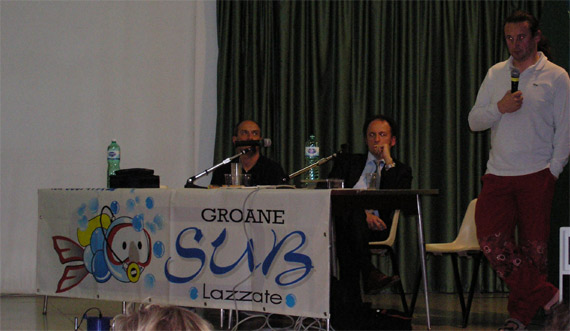
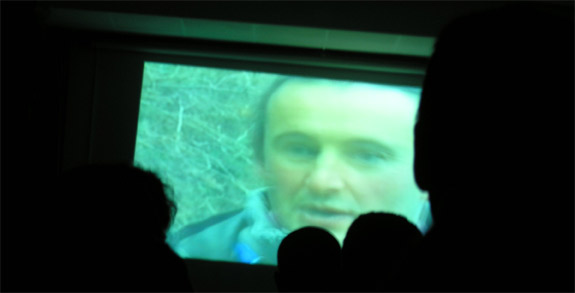
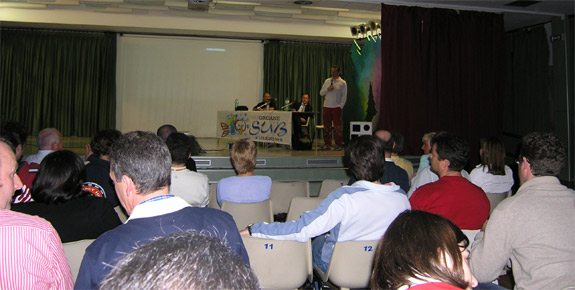
On April 29, 2005, in Lazzate, near Milan, Gigi Casati hosted a wonderful evening dedicated to cave diving. During the evening, Gigi was bombarded with questions that our friends at ScubaPortal.it had collected on the forum… Gigi, always with great kindness and enthusiasm, answered all our questions. Here are the main ones!
from Virman:
Q) What draws you to an experience like this? What's the inner mechanism that pushes you further?
Exploration... the taste of the unknown... seeing things no one has ever seen... seeing how far one can and can go...
D) During a new penetration, is everything tied to the initial programming or are there situations in which you have to readjust your programming to the reality of the moment?
A cave diver can plan an exploration up to where the flooded tunnel is known.
When he begins to travel into the unknown, the cave diver acts like a computer and processes all the data he receives: his emotions, the external environment and the equipment, thus gradually adapting the dive and the subsequent decompression.
D) What would you like to convey to those who want to get into speleology?
My enthusiasm and mindset for attending this activity.
D) What kind of preparation is required to face an expedition?
An expedition requires participants to have a considerable degree of adaptability.
The psychological aspect therefore remains the fundamental component not only for being able to live on the expedition but also for facing the dives.
Depending on the type of explorations you are going to carry out, physical preparation plays a more or less important role.
D) How do you approach underwater speleology?
It's an activity that requires a lot of dedication... time and desire... adapting to the demands of the environment... hanging out with people who know the business well... sometimes taking courses...
D) How important is it for you to be an “old-fashioned” diver?
I wouldn't want to be a "new generation" diver.
D) Another curiosity... but with all that stuff on you... during an expedition, don't you sometimes have to go through very narrow cracks? What happens in that case? Do you inspect and then go back down? Do you use different equipment? How does it work? (..)
The beauty of underwater caving is that it pushes you to seek new solutions to overcome new limits.
Many bottlenecks have been overcome with cylinders in hand, but when the cylinders are too large to be handled this way, they're abandoned. What wasn't feasible years ago is now possible in many cases, for example, using closed or semi-closed circuits, which are significantly less cumbersome.
D) How do you experience your emotions?
It's hard to express the emotions one feels when reaching new places, never seen by other men, but when I trespass upon very beautiful environments I waste "precious" time to enjoy them but I am immediately called back to concentration since I am under water level and I have to return to the entrance.
D) What is your relationship with the sea? Isn't it too open a space?
It's hard to find uninteresting natural environments; the sea is a world still largely undiscovered. I've learned that to do something well, you have to dedicate yourself completely. I have a good relationship with the sea, but since I'm so focused on exploring springs or caves, I easily forget it and throw myself body and soul into exploring the latter.
from The Captain
D) main differences in technical features (equipment) and procedures from wreck diving.
Let's say that the exploration techniques inside the wrecks are taken from and partially adapted to the environment by speleo-underwater exploration techniques.
D) Recommended locations for those who want to start doing some basic speleology (aside from the beautiful caves of Ustica that I had the pleasure of exploring this summer with several friends from the forum)
Marine cavities must be distinguished from karst springs. The main Italian marine cavities are located in Sardinia, Puglia, and Campania. The main karst springs, however, are found in Veneto, Lombardy, Lazio, Tuscany, Sardinia, and Campania.
from Caesar
D) What effect does a kilometer-long penetration have? How many eggs do you eat?
It depends on many things……..I might even avoid eating eggs…….
from Daniper
D) Has there ever been a dive or a moment when you were really scared?
Fear is an important friend with whom we must learn to have a loyal relationship. Anyone who claims to be fearless when practicing a potentially dangerous sport is either crazy or a liar.
I have had moments of strong “internal tension” on some occasions.
I've lost my thread and had to wait a while to find it again, been sucked into a cave with a reverse current, had strong symptoms of drunkenness, etc.
The ability to remain calm in the face of a problem, knowledge of the techniques and a good dose of luck allowed me to solve the problem.
D) Have you ever said, "I'm quitting"? If so, what made you keep going?
I've had a tough time, as I think everyone does. My motivation has never been technical, but financial. I've given everything I can to my desire to explore caves. The passion is too strong, and so far I've always managed to continue on my path.
D) How do you pass the time during your very long deco stops?
It's a matter of habit; long decompressions are achieved gradually. However, I usually think about the dive, how it went, where I went wrong, where I can go faster, how to improve the equipment, how to solve the problems I encountered during the dive and how to continue, or I simply get lost in thought.
from Little
D) Shall we organize in Rome when you have some free time?
Between November and December…..
from N2
D) How many tons of material do you carry in each shipment?
Back in the open-circuit era, just three years ago, we traveled for large-scale explorations with about 3 kg of equipment. Then, the advent of semi-closed circuit diving began to reduce weight, and now with closed circuit diving, we've significantly reduced that. If I make a comparison, from 40 kg, we now carry about 40. The weight of tanks, regulators, large compressors, mixers, etc. has been almost completely eliminated.
D) How much air (litres) and various mixtures (always in litres) do you use?
It's hard to say. Let's just say that with open circuit I tried to consume over 35.000 liters of gas in a single dive. For the same dive with my semi-closed circuit I would have used 2.500 liters of gas, while now with closed circuit I wouldn't consume more than 500 liters of gas.
D) How many people does your team normally consist of?
There are several people who participate in expeditions throughout the year. I've never liked crowds, so there are usually four or five of us at a time. With the arrival of semi-closed and closed circuits, things have changed significantly: there are no longer huge quantities of materials to move, no more days spent at the compressor, no more tanks to replace in the water, etc., so the workload has been significantly reduced in some ways.
D) Another silly thing: in some photos I saw that you were wearing a blue suit (nylon??) over your wetsuit, why??
It is a speleo suit made of light Cordura that serves to protect the neoprene from abrasion against the rocks, allows you to slide better in narrow passages, etc.
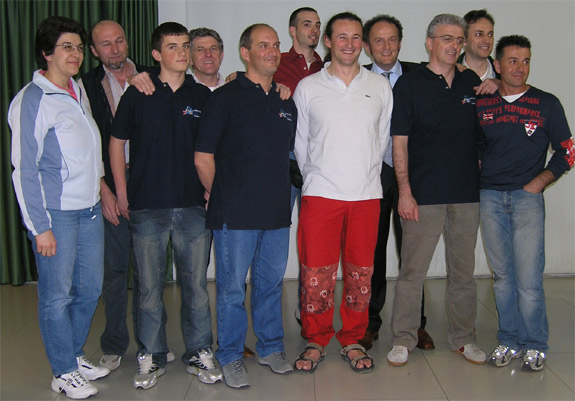
A heartfelt thanks to Gigi for his availability and to Virman for helping me collect the answers.
Reproduction of the text and photos in this article, even partial, is strictly prohibited without the author's consent.