


Authors: Roberto Scolamiero and Marisa Adimari
We departed on a scorching summer day: August 18th, my birthday, bound for Mexico City via Paris. The intercontinental flight was interminable, and the landing was quite painful. The strange thing was that, since Mexico City is so high, we didn't feel the plane descending, but rather felt like the earth was coming towards us. Amid the chaos of the airport, we bought a taxi and outside, a heavy thunderstorm greeted us.
Like any self-respecting metropolis, the things that most catch the eye are the traffic and the hustle and bustle, the dirt on the busy streets and the never-ending honking of horns. We arrive at a hotel that looks like it was furnished by the Addams family, with heavy hangings and dark wood furniture all inlaid, but still comfortable and clean. We go out to buy some alternative food. We are very tired and, as soon as we return to the hotel, the jet lag effect makes us immediately appreciate the comfortable bed. The next day we wake up at dawn: we have the last short flight that separates us from the real start of our holidays. And here we are flying over the Sea of Cortes where the memory of the Love Boat always stopped in Acapulco lingers… The sea is blue, seems very calm and makes us want to take a nice swim!
 When we arrive in La Paz, it's incredibly hot. The transfer to Cantamar takes place with the air conditioning on full blast. As soon as we leave the city, these are the views that come to mind when we hear the word Mexico! Rocky deserts, cacti, and deserted beaches.
We arrive at our hotel: the first impression isn't the best... we're relatively close to a refinery, and just behind the hill is the port where ferries across the Sea of Cortez depart. We pack up our gear: each diver has their own outdoor space, protected by a fence complete with a small door and a padlock. We take a few more tours: there's a pool and a beach. We try to sunbathe, but it's impossible. There's not a breath of wind and the heat is unbearable. The sea isn't all that inviting, too much plankton, and our skin suffers. We spend most of the afternoon lounging by the pool. I have my first hysterical fit when I find what I call a giant cockroach in the bathroom, but they call it, much more romantically, "Cucarache" there!!!
We see all the divers who had been out on the boat since early in the morning returning, and we can't wait to go diving too. Bobbysub is so impatient that after a while, when he sees a small group leaving for the night dive, he runs after them to join them. In his haste, he forgets to reattach the bulb to the J-light, but he notices it in time. They take him to the lighthouse, just outside the small marina that is an integral part of the hotel: a "beautiful" night dive at 15 meters, with the only fauna being 1-meter-long worms... a bit of a disappointment... and above all, he still didn't know how much he'd pay... $45!!!!
First day of diving! Finally, our gills were drying out. As recommended by all OWD diving courses, we started with a light breakfast of BEANS, EGGS, and SAUSAGE!!! I really didn't think I'd be able to eat that kind of food at 7:30 in the morning!
On the blackboards at the marina, we read the association between our names and our destination: Los Islotes, a sea lion colony. The boat is very comfortable. We each load tanks for three dives and set sail. The ride is very pleasant, with calm seas and breathtaking views. We skirt a huge island (Isla de Spiritu Santo), completely untamed and without a shred of shade. As beautiful as it is, it must be scorchingly hot (and to think they offered us a three-day camping trip there... for a modest price, at that... $800!! Thank goodness we didn't accept!).
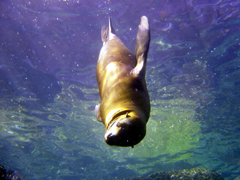 After about a couple of hours, these rocky outcrops emerge from the sea. As we get closer, everyone looks curiously: sea lions are definitely sprawled on every exposed rock. It's time to get dressed. I smell a strange odor, and after looking around suspiciously, I realize it's the colony of birds that inhabit these islets... I laugh for having thought badly of my neighbors on the boat.
During the briefing, we were told that the cubs were born around the beginning of July. They're just over a month old and are curious and playful. The fathers, however, are quite protective, so it's important not to get too close and, above all, to look for warning signs that someone is being too intrusive and, if necessary, to move away. I, being very brave by nature, know I won't get too close...
We dive in. We're about 4 meters deep. I find myself in the middle of a school of divers, some waving their fins, others waving their arms, inviting the pups to play with them. Meanwhile, I graze around, but suddenly I see a shadow above me: it's a pup who particularly likes me. After trying in vain to bite my fins, he wanders around me and finally positions himself on my tank... I know he's there but I can't see him. I decide to move away, but he follows me and at a certain point he bites my shoulder: frightened by this slight pressure, I move away forcefully, and his teeth hurt a little, but nothing serious: my escape continues, and at that point I look up and realize I'm the center of attention of all the divers who were waving their arms before... some of them tell me to stay calm... why??? I'm not nervous at all, I just have a pup (whose canine teeth are comparable to those of a Dobberman...) who chases me and attacks my fins! Luckily, he gets bored and eventually leaves me alone. Bobbysub stayed to film me, amused, throughout all this…
After this "dive," or rather, this very long safety stop, we return to the boat and do two more dives that day: there's plenty of fish, but nothing special. The seabed isn't very colorful and can't be compared to the Red Sea or other tropical seas. The water is so rich in plankton that in some places it's almost impossible to swim without a wetsuit. You have to pay close attention to your ears and clean them thoroughly after each dive. (We use the trick of applying a little Baby Johnson's oil before diving so that the plankton doesn't stick to your skin.)
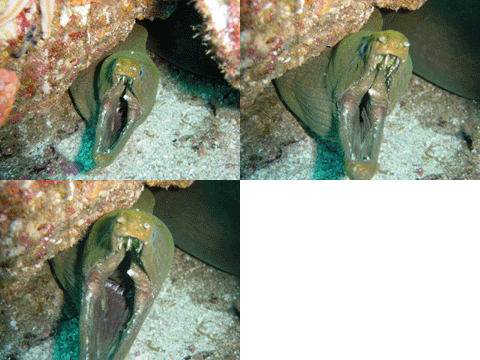
The following days continue with these pleasant boat trips. On one of them, we go to "El Bajo": it's a submerged mountain whose tip is 20 meters below the surface of the sea. The coast is visible, but it's really far away. It's quite a shock to dive in the open sea. This spot is famous for being home to a school of hammerhead sharks, but given the water temperature (about 30°C), it's highly unlikely we'll see them. The best months are February-March (for a change, we're in the right place at the wrong time), but in those months the sea is often rough, so it's not always possible to reach this dive site, which offers no shelter. We dive in. I have to say, this is a wonderful dive, even though we don't have any special encounters. I'm not a big fan of moray eels and I usually don't even photograph them, but here... here, there are an incredible number of them! They are large green moray eels, and in every crack in the rock there are four or five or six or even more! In short, they look more like condominiums than dens! The cap also offers many other forms of life, and this underwater stroll is truly enjoyable. On the next dive, we venture a little deeper, into the blue, but again we see neither sharks nor large pelagic fish.
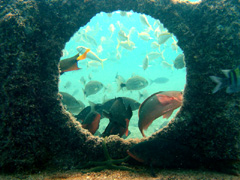 Since both Los Islotes and El Bajo, as well as other dive sites, are quite far away (a two-hour, two-and-a-half-hour cruise), it's common to do two dives and then a third on the way back. The third dive is often done in a channel separating the coast from the large island of Spiritu Santu, provided currents allow. There are a couple of shallow but richly marine wrecks here.
We set off one morning, and the day got off to a great start; in fact, shortly after setting sail from the dock, we encountered a pod of pilot whales. Pilot whales are slightly larger than dolphins, very dark, and have a more hooked tail fin. They live in the Sea of Cortes, and when, during the winter months, the large whales arrive, traveling up this stretch of sea to give birth, they guide them to their destination, avoiding the risk of them running aground in shallower waters.
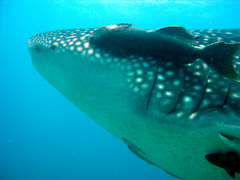
Our destination is La Reina, a spot famous for manta rays, but we can't see a thing, and besides, there's sea, so after the first dive and a lunch spent bobbing left and right, we decide to turn back. We make our second dive to one of the canal's wrecks, "El Salvatierra," where the quantity of fish is truly impressive. 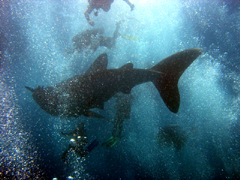 I'm a little tired, so after about 40 minutes I decide to ascend, leaving Bobbysub with the others (he'll continue until the tanks run out, if they let him...). I'm at 4 meters, but I'm finishing my safety stop attached to the rope, when from my left I see a huge shadow elegantly approaching: I can't believe my eyes!!! It's a whale shark, at least 6 meters long! Wow, how exciting! Thank goodness I'm at 4 meters because my heart has started racing and I'm breathing like a bellows... I think Bobbysub is still below and maybe the whale could pass over him and he won't notice... I absolutely have to go and warn him, so I immediately dive back down. In the blink of an eye, I'm at 11 meters and I'm looking for it. All the divers have noticed its presence and the computers are beeping like crazy (sometimes it's really hard to remember to ascend slowly!!!) I find Bobbysub, but he too had already noticed the enormous animal (the beeping computers had alerted him that something special was happening). It's wonderful. Unfortunately, the dive is over, we have to leave. As soon as they get back on the boat, many prepare to dive back into the water to snorkel and admire this sensational and so rare animal once again. Bobbysub is, of course, at the forefront. The whale continues to stay close to the boat and it's possible to spot it even from the surface. We wait an hour and it's still there!!!! Another boat is also called on the radio and immediately rushes over. We're ready for the third dive. Everyone in the water armed with cameras and everything else!
We spent the entire third dive with the shark. Bobbysub took a macro shot of the whale's eye, trying to capture every detail... the animal was so huge that it was difficult to get a photo that captured it all and also highlighted its size! We burned the batteries and memory cards of both cameras! This was the dive that was definitely worth the trip...
An incredible euphoria reigns on the boat, as if everyone had won the lottery. Even the Japanese, who usually huddle together and never let their emotions show, on this occasion abandon themselves to smiles and jumps, waving their arms at the guests on the other boat, just a few meters away; all of this, of course, punctuated by loud burps... they're quite off-putting! Well, you can't expect the impossible... J
 The days pass quickly, and so we finish the package we purchased from Italy. We extend it by a day and, in agreement with other Italian guests, decide to take a boat to Las Animas, a place further away than the others, so much so that we'll only do two dives here during the day instead of three. And indeed, we spend three and a half hours sailing, encountering pods of playful dolphins that we try to film (our friend MAD will later tell us that these shots are so awful, they look like they were filmed in a Super Eight in the 1950s... :). We get to the point: two rocky outcrops emerging from the water. They say there are hammerhead sharks here too, but we can't see a thing. Visibility is terrible, at least up to 10 meters, but it's a little better below that. Nothing to report on these dives... someone saw a guitar shark, but we didn't even see that...
Well, it's time to pack up the scuba gear after 6 full days and 16 dives. Tomorrow we're leaving here and driving around the tip of the Baja in a rental car!
Reproduction of the text and photos in this article, even partial, is strictly prohibited without the author's consent.