




Text Author: Mosè Boldrini
Photo authors: Maurizio Cucchiara, Marco Gallucci, Moses Boldrini
Since January 2003 the Conero Riviera boasts
a precious fish repopulation area and an additional diving point for
those who practice scuba diving and freediving.
This is the wreck of the cargo ship Nicole, which sank due to
adverse sea conditions and the imprudence of those who tried to plough through
the sea to a ship designed for river transport, the low bulkheads and
the absence of a keel did not allow it to cope with the impetuousness of the wind
and waves that ended up causing the shipwreck, fortunately without casualties
among the crew members.
Now, to remember that stormy day, there remains a giant of steel lying
on a sandy bottom in a perfect sailing position. Since May 2004
The wreck has been opened to underwater visits to the delight of enthusiasts
such.
The Nicole allows for very short stays
long, being in fact placed on a seabed of just fourteen metres,
allows diving without having to resort to the use of mixtures that would otherwise be
make them indispensable when the depths to be reached exceed the
30/40 meters.
If the wreck of the Nicole will certainly be
appreciated by those who do not like great depths, it certainly cannot be said
same thing for photography and video enthusiasts; The remarkable
presence of suspension and the nature of the seabed, composed of very fine sand
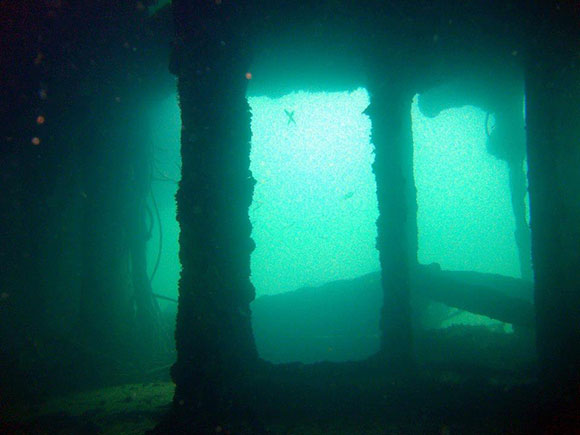
similar to mud, they greatly reduce visibility which varies from one meter to a maximum
of 7/8 meters.
It goes without saying that it is practically impossible to get an overall view of the
wreck, we will have to be content with portraying the colossus only in sectors,
giving up having suggestive images in the archive that give an idea of the
majestic dimensions, it will therefore be useless to say to leave the wide angle at
home and opt for a more short-range lens.
It has long been known that wrecks attract a large amount of marine life and the
Nicole is no exception. Anyone who has had the opportunity to dive at a distance of
time from each other he was able to see for himself how massive and fast
could have been the colonization. The hull, at least externally, appears
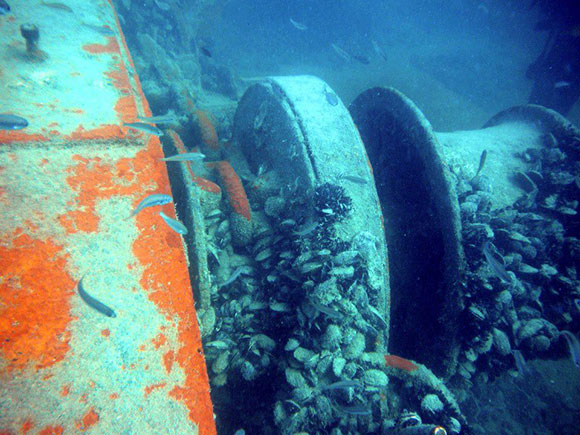
completely covered with a large colony of mussels, sponges and serpulids.
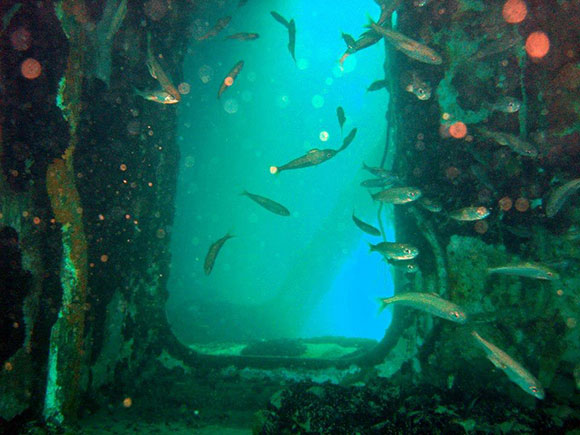
All around and inside the ship's rooms a carousel of dense stalls
of blue fish, mullet, rock red mullet, white bream and sea bream. When the
visibility allows it is possible to spot solitary hunting dentex which, with
their sudden attacks interrupt the harmonious dance of the colonies
sedentary.
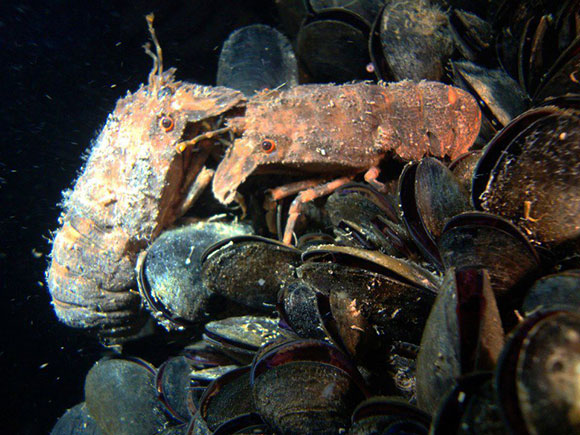
In the ravines we will be able to spot scorpion fish, shrimps and blennies, in the
Night dives are frequent encounters with lobsters, crayfish, cuttlefish and
large conger eels.
The Conero Riviera also offers the
possibility of diving on the coast, it's incredible how much they can
differentiate themselves from a biological point of view if we compare animal species and
plants that populate the wreck instead. Diving among the sheets of the
Nicole we may find ourselves in the presence of aquatic life that is not present on the coast
proliferated leaving space for other forms of life due to the different
present environmental conditions.
We have already said that the Nicole dive does not present any particular
difficulties however, given the poor visibility especially in the presence of
sediment in the internal environments, a visit with a guide is recommended
local expert who will be particularly useful if you want to carry out
penetrations with the certainty of avoiding unpleasant emergency situations.
I think it is important to remember that visiting wrecks and in particular to carry out
penetrations, training is required and highly recommended
I specify that you focus on the equipment to be used and on the
identifying and managing problems that may occur in these
particular environments.
The dive
After the briefing on the ground we load our
equipment on the dinghy, we only have to sail for ten minutes, the
Nicole is located just two miles off the Numana marina, from
promontory of Mount Conero the unmistakable smell of maritime pines reaches
of Mediterranean scrub.
Local dive centers have placed some mooring buoys both at the stern
than at the bow.
The groups form and we start to go down, the Nicole should be right
below us just 8/9 meters below but the only things that can be seen
see those are the guide's fins ahead of me.
Suddenly a huge black figure appears in front of us, it's Nicole.
We are literally enveloped in a cloud of fish that is sinuously swirling, almost
not at all frightened by our presence. Looking everywhere we see
the incessant swarming of marine life that populates the sheet metal, the silence makes
as a master.
Time to take a look and respond
at the ok of our guide and we begin the exploration of the lower floor of the
aft castle, the upper floor where the command bridge was located is
collapsed and therefore no longer exists. The internal rooms are very bare given
that the sea has swept away almost everything, where the sea has not reached are
divers arrived looking for easy souvenirs.
What catches our attention are the dense colonies of fish that move
ahead of us, as if to give way to the unexpected visitors they move
from one environment to another as we pass by. I take pictures here and there, but the
The suspension I see already tells me that they won't come out as I would like. Up to 2
Years after the sinking there were traces of life on board and it was easy
recognize rooms such as the kitchen, ironing room, bathrooms, TV room and
crew quarters. Almost all the objects that testified to the life of
on board have been plundered and will now be on display in the living rooms of some
diver with little respect for those who visit the ship after him. Some
probably unaware that removing a part of a wreck or its
furnishing is a crime punishable by law.
Below us is the engine room, but the lack of escape routes and
The composition of the muddy bottom discourages its penetration. Let's leave
these tasks to those who have more knowledge about diving in this type of
places.
Finished exploring the remaining floor
we begin to travel along the side of the vessel, we make some descents
in the three large holds still with their cargo intact which appears to us as
sand. In the hold we see the antennae of a small lobster that make
peeking out from between the sheets of metal, its position is so sheltered that my
The lens and the bulky flash mounts don't allow me to portray her.
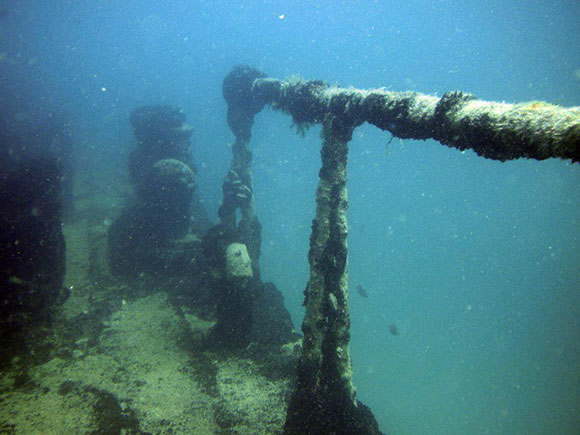
At the height of the second hold the tear caused by the impact is clearly visible
with the seabed, to remind us that we are on a ship are the external handrails, the
bollards and hatches that we encounter along our route. Given the
poor visibility along the holds it almost doesn't feel like you're on a ship
sunk.
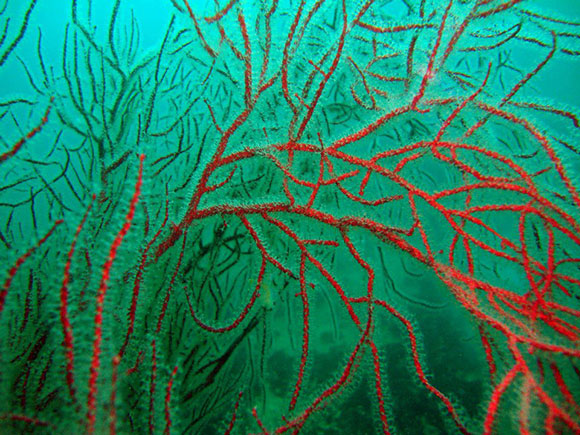
The third hold holds an unexpected surprise: a colony of gorgonians.
Gorgonians are not present in this part of the Adriatic, they have been planted
for a study by the university of marine biology and they managed to take root
thanks to the presence of many nutrients in the water. As proof that
This part of the Adriatic is very rich in life and is still in good health.
Our progress leads us to finally glimpse the forecastle wrapped in
it too is a whirlwind of marine life.
There are not many internal spaces to explore here, only three rooms left
practically preserved as at the time of the sinking but, given the environments
very narrow they allow the entry of only two divers who, however
masters of the set-up, as they pass they cannot help but raise the annoying
sediment that makes the visit of others dangerous and practically useless
hikers.
We take two powerful winches to the deck of the aft castle
they still wrap the huge anchor chains.
We make a suggestive descent along the keel of the ship, here it is possible
to estimate the size of the wreck, it seems impossible that once that same
keel was ploughing the sea and now it is there, motionless in front of us.
The port anchor is lowered to the bottom buried in the sand, the starboard one
instead it is still in its housing, a convenient refuge for scorpion fish and blennies.
We follow the opposite side backwards to that one
of the outward journey to return to the summit for the ascent. Throughout the
On the way back we are accompanied by a school of bogue that seem to have
decided to act as our guide. Along the outer side you can see numerous pieces
of the ship scattered all around which especially at night could
constitute a separate dive.
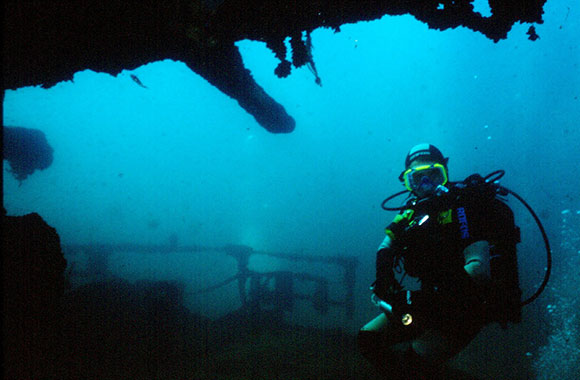
A last look through the portholes at the rooms
inside and we begin our ascent, visibility today does not allow us to
We're not going to visit the huge propellers, so we'll give up. Even from this dive, I'm...
re-emerging carrying imprinted in my mind some of the things I saw. Each
Every time a diver finds himself in front of a wreck he cannot help but think,
at least for a moment, to the greatness and power of the waters that have
swallowed, it's difficult not to abandon oneself to epic sensations that have always tied
man and sea. Thanks to Nicole, today I am also resurfacing, bringing with me
new memories surface…old emotions…
A little bit of history
On January 27, 2003, sailing off the coast of
coast of the Conero Riviera, the “Nicole”, a river transport motor vessel
flat-bottomed vessel from Türkiye bound for Porto Marghera, yes
he was in difficulty due to the rough sea and the north-east wind;
the crew refused the help of the Coast Guard and, in the hope of
find shelter, he approached the southern shore of Mount Conero where, at
on the contrary, a series of waves went over the sides flooding the holds and the ship
was starting to sink due to too much weight; Given the flat bottom, the Nicole is
sank while remaining perfectly upright and settling on a sandy bottom
of 13/14 meters.
The Nicole was carrying a cargo of 2.800 tons of Feldspar, a material
quarried stone aggregate used for the processing of glass and ceramics.
The alarm was raised immediately and the Coast Guard and ARPAM (Regional Agency
for the Environment of the Marche) intervened promptly by putting under
I check the wreck and the surrounding waters the next day, while the
pollution control vessel “Città di Ravenna”, recovered 60
tons of diesel fuel from the tanks and oil from the engines of the wreck, the motor vessel
ARPAM's "Sibilla" proceeded to take water samples to detect
presence of chemical pollutants, oils, and hydrocarbons. For a more complete
surveys were also carried out on the seabed surrounding the vision
wreck and some cargo samples were taken to check that the
feldspar did not contain additives and pollutants.
ARPAM declared, just a few days after the event, that what could
be an ecological disaster, for a Riviera that has tourism as its mainstay
main resource, fortunately it had been avoided.
The sampling data, compared with those carried out in the same area
August 20 and October 15, 2002 were all normal.
Who to go with
Sea Wolf Diving –
www.seawolfdiving.it
Reproduction is strictly prohibited, even
partial, of the text and images in this article without the author's consent.