


Author: Francesco Turano
Mediterranean Cerianthus
I learned to understand and appreciate marine invertebrates only after donning scuba gear in 1985. Freediving, as exciting as it is, doesn't allow you to observe the details of some animals, especially invertebrates that live in close contact with the seabed. Breathing underwater, however, allowed me to study up close and for relatively long periods a fauna I had only superficially known as a freediver. The first invertebrates to strike me were coelentrates, and among these, I was immediately drawn to cerianthus, one of the most morphologically attractive and aesthetically elegant creatures in the sea in general and the Mediterranean in particular.
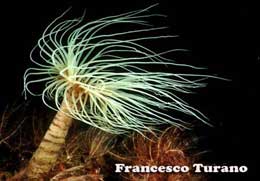
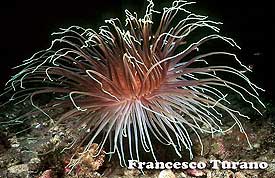
The cerianth is an animal with a delicate, soft body, very similar to that of a sea anemone, but without a pedal disk. To compensate for this deficiency, it clings to the seabed, living within it in a self-created burrow, where its body is protected by a membranous sheath formed from congealed mucous, which the animal spontaneously and continuously secretes. This leathery covering is therefore particularly robust and provides the animal with considerable protection. Conducting its life hidden inside a long tube, a sort of "bundle" whose terminal portion protrudes from the seabed, the cerianth frequently unfurls its phantasmagorical crown of tentacles, arranged in as many as four concentric rows. Over 100 tentacles, protruding from a tube rising from the seabed, give the cerianth a decidedly majestic appearance; as beautiful as it is resistant and long-lived. The animal is said to live for over a hundred years, and some specimens I photographed in the waters of the Straits of Messina and Lampione at depths of around 35-50 m, always on the edges of deep reefs, seem to support this hypothesis, which I find very realistic. Tubes rising up to 20 or 30 cm from the seabed, not counting the buried portion tenaciously embedded in the sediment, with crowns of tentacles over 50 cm in diameter, give an idea of the maximum size of the older specimens.
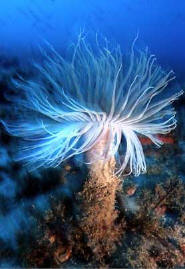
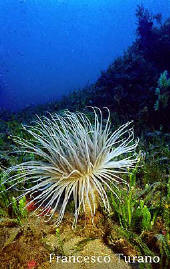
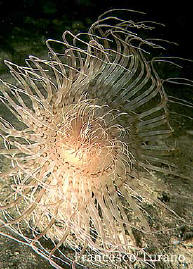
Adding to the already beautiful morphological appearance is the coloration of the tentacles, which is decidedly variable. I've seen cerianthids with solid purple-black tentacles, and with rust-colored, orange, fluorescent yellow, brown, and deep white tentacles, with or without fluorescent tips. I've also seen tentacle thickness vary from specimen to specimen, particularly noting fleshier tentacles in those cerianthids with a whitish color. Sometimes the tentacles have several concentric rows of different colors, with the outermost row white or yellow, and the other rows purple or whitish.
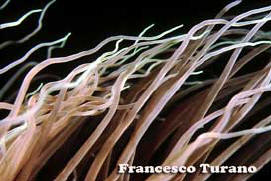
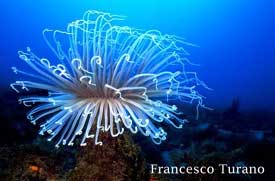
But these are just the most common situations. The cerianthus keeps its tentacles open both day and night, although in the dark they are more likely to extend further. It prefers scree or sandy bottoms, or areas at the edges of reefs, without disdaining the edges of seagrass meadows, where I have encountered significant concentrations of specimens per square meter of seabed. If touched, it doesn't necessarily retreat inside its protective tube, but it probably performs a jerk that leads to an initial contraction of the tentacles, which curl at the tips, and then it withdraws into the tube, sometimes disappearing from view if subjected to excessive stress. It can also close directly, bypassing the intermediate contraction phase. It prefers places moderately exposed to currents, for feeding reasons, but does not disdain the quiet, dark environments of caves, especially those with muddy bottoms. It therefore practices all environments of the underwater world but, depending on the places and sites, it takes on different appearances.
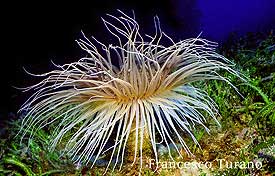
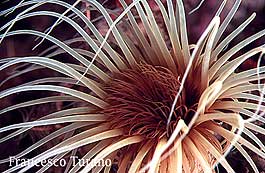
For divers wishing to observe or photograph these splendid animals, I can offer some advice. First, I'd like to point out the presence of centuries-old cerianthus, of considerable size and spectacular subjects for underwater photography, in the waters of the Strait of Messina, on the Calabrian side (localities: Scilla and Bagnara, depths between 40 and 60 m), and in the waters of Lampione, an archipelago of the Pelagie Islands (at the base of the reef, on the sand, around 50-55 m deep). I have not found cerianthus with similar characteristics elsewhere, but this does not rule out their presence. Regarding my research in the Mediterranean and my personal experience, I have found animals of every type, shape, and color in the most diverse places and on all sorts of seabeds. What I consider significant, however, is the presence of cerianthus on the Sardinian seabed, especially in some caves along the rocky coastline overlooking the sea; Cave cerianthids, widespread throughout the Mediterranean but particularly well represented in Sardinia, have a large portion of the "tube" containing their bodies lying on the sandy or muddy bottom, and therefore more exposed. They almost resemble large sea cucumbers (echinoderms known as sea cucumbers due to their cucumber-like appearance) with one end pointing upward and the other buried in the sediment. The upward-facing end exposes beautiful, long, and thin "fountain-shaped" tentacles, hazelnut, mustard, purple, black, or white in color, in a single hue and without stripes or other patterns (these are the most common). Sometimes, some caves host gatherings of cerianthids with their chitinous tubes elongated and/or overlapping or side by side, offering a spectacle of rare beauty if you witness all the tentacled crowns unfurling at the same time. Finally, based on observations made in nature, I have no hesitation in stating that cave cerianthus, which prefer fine sediment and total darkness or dim light, almost always have thinner tentacles and colorations that do not differ from those mentioned above.
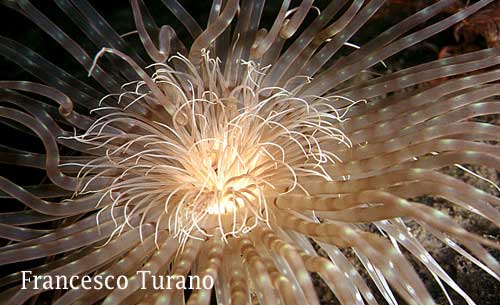
Conversely, the cerianthus, which I would dare to call "classic," have their bodies almost completely buried in the sediment, leaving only the terminal portion of the tube protruding, almost always in a vertical position or, at most, with some lateral inclination depending on their location on the seabed. The tentacles are generally fleshier and progressively thinner towards the tips, and their color varies greatly, from greenish-white to green to fluorescent yellow, as well as repeating all the hues already seen for the dark-loving cerianthus. There is a site in the Strait of Messina, just north of the city of Reggio Calabria, where numerous medium-sized cerianthus live on the edge of a spectacular seagrass meadow in just 6-10 meters of depth. Night diving here offers intense excitement for those interested in studying and observing these coelenterates. Going deeper, in the same place and in the surrounding area, on the sandy and detrital slopes that point decidedly towards the depths of the strait, you can observe isolated cerianthus of medium-small size with bright yellow colors, which stand out quite a bit against the gray sediment.
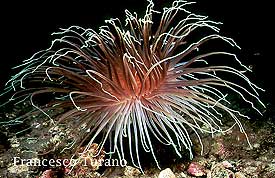
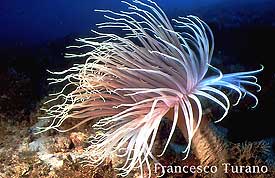
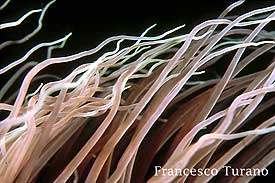
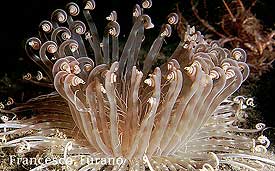
Sometimes called "flowers of the sea," cerianthus are animals that can be observed very closely by divers and thus appreciated in all their charm; photography and video enthusiasts will find them a very interesting and particularly photogenic subject.
Reproduction of the text and photos in this article, even partial, is strictly prohibited without the author's consent.