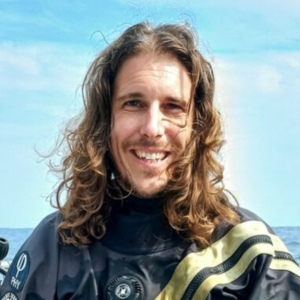




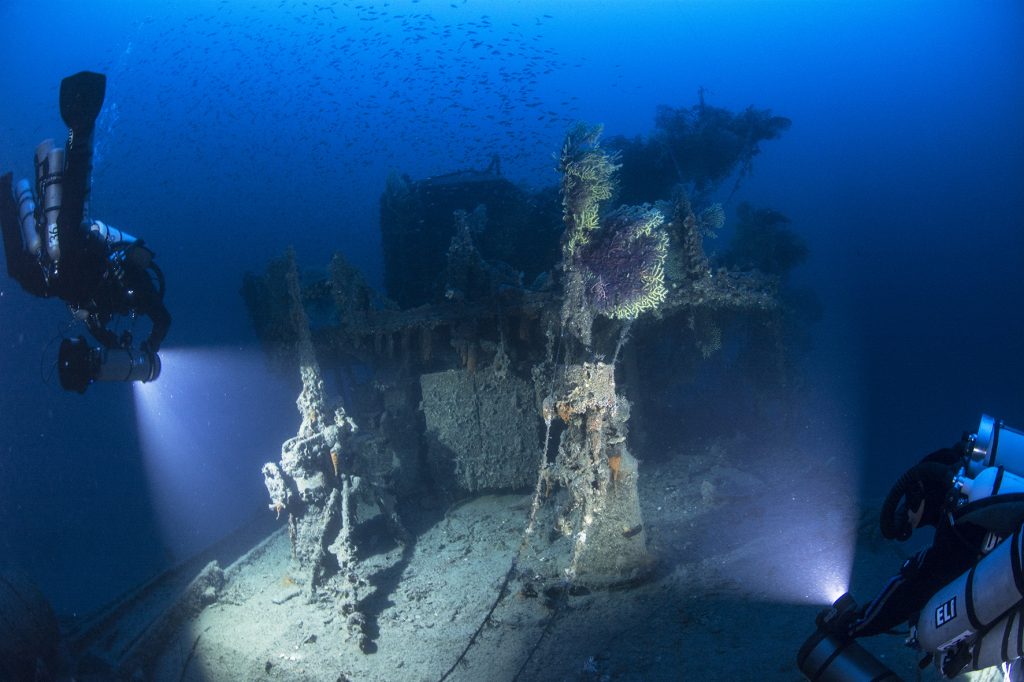
Two men gaze at water from opposite ends of the globe. The first lives in California, the second in Italy. They gaze at water differently, but share the same destiny. They don't yet know this, until the third man appears: the key figure in this story.

Fabio Ruberti hands the young diver, Mario Arena, copy no. 7 of the American magazine specializing in technical diving and edited by Michael Menduno. The magazine was published in December 1993, a month earlier, on November 7th, Ayrton Senna won his final Formula 1 race, and his eternal rival, Alain Prost, ran his last race before retiring from the world stage.
Seven are the Pleiades, seven are the strings of Apollo's lyre, seven are the columns on which the World rests, supported by the shoulders of a giant, seven are the hills on which eternal Rome stands, seven is the Buddhist number that indicates completeness.
Seven is the number of the magazine acquaCORPS which changes the course of technical diving in Italy, contains, among others, the writings of Dr. RW Bill Hamilton, John T. Crea, R. Pyle Phillip. The following is the first part of an interview that talks about the past and future of the technical diving through the eyes of the protagonists, then and now.
What was the main goal of aquaCORPS?
Michael Menduno
I was hungry for knowledge and wanted to learn more about the genre of diving that was developing in the late 1980s and early 1990s. At that time, "technical diving" hadn't yet been defined, so I decided to found aquaCORPS. Our primary focus was research focused on the "technical" aspects that influence diving, such as medicine, dive culture, and technology.