




Author: Aldo Zanetti
Our trip's destination is the Philippines, specifically the small island of Olango, in the Sulu Sea, about 18 kilometers east of Cebu. We chose Olango because the Sulu Sea is beautiful, and since it's still relatively untouched by international tourism, it offers attractive prices. The island (about 8 square kilometers) is covered in equatorial vegetation, home to a variety of bird species and nocturnal mammals. There are two resorts on the island, each offering different levels of accommodation, both offering diving.
The trip was quite tiring: about a 23-hour flight to Cebu with a long layover in Hong Kong, then an hour-long van ride on Cebu Island to the pier, and a final one-hour outrigger boat ride. From our departure from Malpensa, day alternated with night and day again, and we were quite exhausted. But when we crossed the deep blue sea and finally landed on the white beach, we realized it was worth it, and the fatigue quickly melted away. It felt like we had arrived in a little paradise still unknown to most. Palm trees reach the sea, the vegetation is lush and verdant, and the scent of flowers wafts through. The resort is spartan but welcoming, with a central building housing the restaurant and reading room. Surrounding it are a few small cottage-like buildings that house the accommodations.
Now the serious part begins: let's go visit the diving center. The equipment is quite modern, nitrox is available, and in the training room, there are some manuals on local marine species. The diving center is run by two Swiss guys who don't speak Italian, but we manage well with English. There are about thirty dive sites around the island, no more than a 45-minute boat ride away. Many can be reached in 15–20 minutes. The overall impression is positive: good!
Soon, it's dinner time: we're at the equator, and it's light from 6 a.m. to 6 p.m. The cuisine is local, with seafood dishes infused with the flavor of coconut, which is omnipresent here. The following days will also feature the same style of cuisine: good, though not particularly varied.
The next morning at 9:00 a.m., we set off for our first dive. The dive boat has the typical shape of a large pirogue with two side outriggers and is more comfortable than one might expect at first glance. The diving equipment has already been brought aboard by the two guides, and there's plenty of space. Considering the short distance, the accommodations are more than adequate.
Within about ten minutes, we're at the dive site. We get dressed and dive into the water; a quick check, and the adventure in the equatorial sea begins!
 Once underwater, the scene before us is breathtakingly beautiful: we're faced with a wall covered with an extraordinary abundance of life, including soft and hard corals, sponges, and sea squirts, among which myriads of tiny creatures swarm. The light shines brightly and the colors are brilliant; the red of the coral mixes with the blue of the sponges, and the fish are white, yellow, and multicolored. We descend to our maximum depth, less than 30 meters, and what a splendor! I turn and see clouds of fish slowly moving in the blue, occasionally snapping open at the sight of a passing predator. The water temperature fluctuates between 29 and 30 degrees, and will remain so on all our dives.
We continue our immersion by taking photographs of each new subject, and I bless digital photography, which allows us to take practically unlimited sequences even with a small camera like my compact one.
I notice large blue starfish, 3-meter-long red gorgonians, and anemones inhabited by brave clownfish that confront us, defiant of our size. In a pearly globular anemone, I look closely and spot a tiny blue-purple shrimp peeking out.
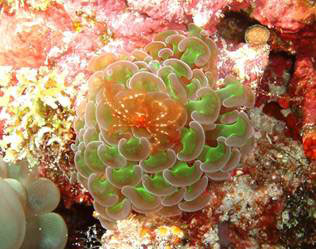 Surrounding us are gray and blue elephant ear and trumpet sponges, and as we ascend to shallower depths, I see some lionfish swimming lazily among the corals. After 45 minutes, we ascend to a plateau at -5 degrees Celsius, ideal for a safety stop. We wander through the coral garden among a myriad of crinoids surrounded by schools of black and white damselfish. We surface after an hour, and despite using 12-liter tanks, almost all of us still have 50 bar left. I congratulate the guide on this splendid, well-managed dive; and his smile is much more than just a faux pas: it shows genuine professional pride in a job well done!
At the resort we refresh ourselves with a plate of soy and egg noodles, and in the afternoon we tackle the second dive.
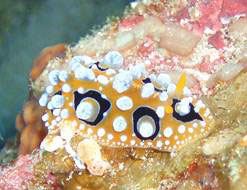
As we descend, we are once again surrounded by all the beauty of this sea. We immediately encounter a school of white and yellow butterflyfish, and a little further down, in a small cave, we find some brown batfish with orange edges. Everywhere is a riot of multicolored sponges and madrepore, thread, and brain corals. Some soft corals sway in the current; they are orange, purple, and yellow. On the sponges, I photograph several species of nudibranchs, black and pink Phyllidia and metallic blue and silver-gray Chromodoris willani. Among the corals, I notice a black cowrie, covering its pure white shell with a midnight black veil. I am so enchanted by the beauty of my surroundings that I almost don't realize that time has already passed and we must ascend to 5 meters for a safety stop!
On the way back, we compare photos and discuss the names of the animals we've seen. We're so excited that dinner arrives almost without us realizing it, and night falls quickly. As we drift off to sleep, we hear a wild concert of nocturnal animals howling, warbling, and calling to each other in the nearby jungle. Finally, sleep and the nitrogen overwhelm us, and we drift off to sleep.
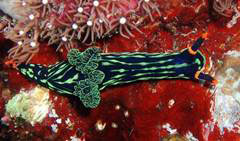 The next day, we set out to hunt for some of the most sought-after creatures on these seabeds: pygmy seahorses. I know they're very camouflaged, but when, after a few minutes of diving, the guide calls us and points out a branch of coral, I struggle to spot the seahorse, so similar is it to the support it's clinging to with its tail. The coral is pink with red polyps, and the seahorse is pink, the same pink, with red protuberances, the same red! I take several photos, and as I walk away, I spot a splendid black and green nudibranch among the soft corals: it's a Nembrota kubaryana, a true tiger of the seas, carnivorous and voracious. The spectacle continues behind me: I turn and in the blue, a few dozen barracudas are passing by, glistening in the sun. My heart races as they begin their carousel, swimming in a large circle. As we ascend to a depth of 15 meters, I observe some sea anemones with their clownfish sheltering among their tentacles. They come in a variety of colors, from the classic orange-white of Nemo to red and white, brown, and pale pink. These little creatures are truly amazing, darting toward us to drive us away from their nest, heedless of the danger!
We reach another plateau at a depth of five meters for three minutes, and among the seagrass, the guide points out a seagrass ghost fish. Once again, I'm fascinated by the camouflage ability of marine creatures: it looks just like a seagrass leaf, and sways in the current like the plant.
A little further on there are some sea cucumbers of different types, among which a white one stands out with elegant black patterns on its body, which everts numerous white filaments.
I try to stay in the water as long as possible, and they “fish me out” by force after almost 80 minutes of immersion.
After lunch, I stroll around the resort's cottages and spot some young men sharpening machetes—large, long knives. Seeing that I'm a little perplexed, they laugh and point out the nearby palm trees. Then one of them begins to climb the trunk barefoot in a way that seems incredible to me, and in a few seconds he's 20 meters up in the air. He pulls the machete from his belt and, with a well-aimed blow, cleanly severs the stem of a coconut, then another, and another. As the coconuts fall to the ground, he quickly descends again and grabs one. With a single blow, he slices it in three-quarters, and finally, quite satisfied, he hands it to me, inviting me to drink the juice. It's sweet and strong-tasting, but faced with such a display (and with such a machete), I can't help but say I love it, and little by little I gulp it down, earning the boys' approval. When I offer him a dollar in payment, he's delighted and lets me know he'll go get more for me. I barely stop him, explaining that I have another dive to do and can't drink too much...
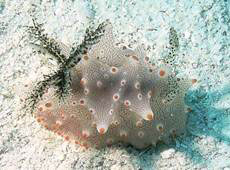
And indeed, at 3:00 we're back on the boat, this time heading to the moray eel plateau. This will be a mud dive, in a landslide where hundreds of moray eels have their lairs. The sight is a bit spooky, partly because of the dark clouds that have blocked the sun and are starting to rain. Everything is gray below, and as we get closer, we see these slender moray eels protruding 50-60 centimeters from the muddy bottom. As we get closer, they begin to retreat into their lairs, and soon there are none left. We swim a meter off the bottom, trying not to stir up too much sediment, and we come across a seahorse, then some gobies. Attached to a boulder protruding from the bottom is a small, white frogfish. I photograph a dwarf pegasus fish resting on the sand, and a splendid Halgerda Batangas, a white nudibranch with spikes like a Gothic cathedral, with lots of yellow dots at the tips. I come back with a good haul of photos and only one worry: how can I refuse another coconut?
 Luckily, this doesn't pose a problem, and dinner goes smoothly, even though I only have vegetables and an omelette to avoid the fish, which tastes like—guess what?—coconut!
Early the next morning, we set off for another dive, this time on the other side of the island. After a 40-minute sail, we arrive at a small bay, a quick check, and then we dive. Here, the scenery is a bit different: not only coral-covered walls, but also some sandy landslides. We descend to 28 meters and encounter our first notable encounter of the day: a red ghost tubefish standing motionless among the branches of a red coral. Once again, I'm amazed by our guide's ability to spot such a mimetic creature. Shortly afterward, I spot some white nudibranchs with blue and yellow stripes on some barrel sponges: they are Chromodoris annae. The dive continues along the classic multilevel profile, and at 12 meters, we spot a splendid specimen of Aegiris minor, a fluorescent yellow nudibranch with delicate black streaks.
A few jackfish swim by in the blue, wreaking havoc among clouds of small cobalt triggerfish. Corals and sponges overlap on the rock, and entire sections of the wall seem to pulsate with the rhythmic closing of the xenia polyps. A few Fromia nodosa starfish stand out for their delicate red and white tessellated pattern. Time flies as always, and soon we're at five meters for our stop and then back on the boat.
In the afternoon I decide to skip the dive as I'll be doing the night dive this evening, and I go do some snorkeling on the reef in front of the resort.
The seabed is sandy with large beds of seagrass and numerous sea cucumbers, biscuit starfish, and long-spine sea urchins. 100 meters from shore is the drop-off, preceded by a coral garden, mostly hard corals—mother coral, brain coral, and bread coral—among which swim myriads of small fish such as black and white damselfish, Picasso triggerfish, and blue and yellow surgeonfish (Nemo's Dory!). On the coral, I often see the fearsome crown-of-thorns starfish, which devour the polyps, causing serious damage to the reef.
When sunset finally arrives, I can't wait to jump into the water and do what will probably be the most beautiful dive of the trip: the night dive.
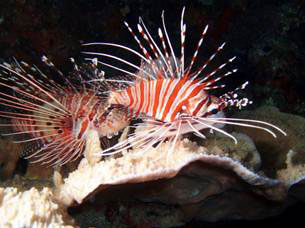 We dive a short distance from the resort and are immediately greeted by a phantasmagoria of marine creatures. Everywhere we see dozens of crinoids rhythmically waving their arms in search of food, and then the soft corals, all beautifully blooming, offer a fantastic array of red, yellow, orange, purple, blue, and green. There are so many lionfish it's hard to count them, and colonies of Stenopus Hispidus shrimps move busily among the flat corals and sponges. On the bottom I see two enormous red hermit crabs speckled with electric blue, elegant beige and hazelnut conidia, and brown and white cowries hunting for prey with the everted tactile veil surrounding their shells.
But the real attraction of the dive is a mantis shrimp (Lysiosquillina lisa) that has been living there on the sandy bottom for at least eight years. The guide lures it out of its burrow by waving a small fish on a stick, and the shrimp finally emerges. It's 20 centimeters long, and its claw-like claws make it look very similar to a praying mantis. While I'm taking some photos, it senses its prey—the fish offered to it—and snaps its claws, clawing at it before disappearing in an instant back into its burrow. A truly moving scene! As I ascend, I see a large porter crab, over 30 centimeters long, among the rocks, carrying a red sponge on its shell as if it were a blanket to protect itself, and then several sleeping fish, including a blue and yellow pufferfish and a yellow and green filefish.
In the evening I fall asleep with the splendid scenes I experienced during the day still before my eyes.
On the fourth day, during the briefing, the guide explains that today we'll encounter a current as we'll be diving in front of the wall of gorgonians, which grow there thanks to the constant exchange of water that brings nutrients. We'll have to descend fairly quickly and then let the current carry us, with the boat following us to the surface to pick us up at the surfacing point.
We enter the water with a hint of apprehension: many of us have already experienced strong Maldivian passes, and not everyone is thrilled. Fortunately, the current is much less powerful, and we all manage the descent well.
We reach 30 meters (it will be the deepest dive of the series) and the spectacle of the gorgonians before us is truly unique! The branches are enormous, some stretching over 5 meters, and at this depth we see them as blue, but I know full well that this is only the effect of selective color absorption, and that they are actually a bright red. I wish I had a flash and a professional camera to take photos that match their beauty and capture them in their red, but that's how it is, and I'm content with what I can get with my compact camera.
As we travel along the wall and slowly ascend, I spot a blue moray eel with a yellow ribbon in a crevice and next to it a black moray eel with a white ribbon: they are two specimens of the same species but of different ages, and one of the two has already undergone the sex and livery change typical of these animals.
On the wall, as always, there is a riot of sponges, corals, ascidians, with a side dish of brittle stars, nudibranchs, and sea worms.
As we ascend to 5 meters, we're greeted by a new and different sight: a school of thousands of sardines stationed beneath our boat. They move in a compact, jerky fashion, as if they were a single fish, and when they head toward us, it feels like we're in the middle of a violent downpour, except that what's darting all around us are sardines!
The dive that awaits us this afternoon is highly anticipated: we're going to see the mandarin fish! These small fish are known for two characteristics: their bright livery, similar to the fabrics worn by ancient Chinese court dignitaries, which earned them the name Mandarin, and their proverbial shyness.
We descend into the water and set up camp at seven meters, in front of a rock with some crevices and a patch of bleached coral. There are three of us, and we position ourselves so we can all take photos without interfering. The wait begins. Minutes pass, it's dusk, and the light is gradually fading. Still nothing. After a good 20 minutes spent motionless (and thank goodness the water temperature is 29 degrees, otherwise you know you'd get cramps...) finally a first tiny head peeks out from a hole in the rock. No one takes a photo, so as not to scare the shy ones with our flashes.
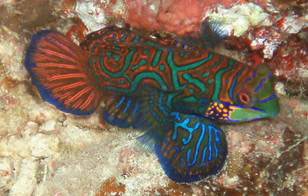 After a while, a first brave one emerges and immediately dives back into the den. The ritual continues for a good 10 minutes, until our mandarins finally gain courage and begin to emerge and linger in the open water, first two, then three, then five. The courtship begins: the larger male leans against the female's hip, and together they ascend a couple of meters toward the surface, holding each other, almost embracing, until they suddenly separate and dive back into the white coral. Finally, we can take photos freely: I'll take over 200 to get a decent ten. We stay in the water until it's pitch black, and when we resurface, the computer tells me we've been underwater for over 75 minutes.
By evening, the photographers' circle has formed. We review the photos, consult manuals to identify the species we've observed during the day, exchange email addresses and promises to share the best shots. The resort owner looks at us and shakes his head. Who knows how many other enthusiastic divers he's seen repeat the same scene? Well, now it's our turn, and we're going to enjoy it to the fullest!
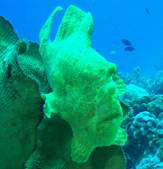 Fifth day of diving, dedicated to searching for frogfish and pygmy seahorses. We descend in front of a beautiful wall that disappears into the depths well beyond recreational diving; the charts indicate that within a few hundred meters of the coast, the seabed is at around 900 meters. There are some enormous elephant ear sponges, a beautiful acid yellow, and on one of them, a large frogfish, motionless, calmly waiting for us to photograph it.
A question comes to mind: why don't we call it a facefish, since it so closely resembles a human face? The wall is dotted with yellow creatures, and in fact, on a yellow coral, the guide shows us a tiny pygmy seahorse, perfectly camouflaged by its yellow protuberances, like the coral. And shortly after, another coveted photographic prey: a yellow ghost tubefish, rarer than the red one we saw a few days ago. Again, I wonder: how the hell does our guide spot them?
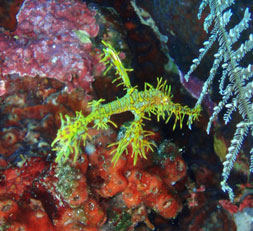 As we continue our dive, I spot a coral grouper, red with its electric blue spots, some flutefish, and a leaffish swaying like a brown and reddish autumn leaf in the wind. As I ascend, I spot one of the strangest nudibranchs I know: a Phyllodesmium Colemani. It resembles the Gorgon's head, or rather, her snake-like hair. It's hard to tell where the front is and where the back is...
By the time we get out of the water, 65 minutes have passed and I've taken about 120 photos.
Lunch, relaxation, and before diving in, we witness the little scene of a dog among the various semi-strays roaming the island. Perhaps attracted by something in a trash can, he's crawled in nose-first, and now his hind legs are flailing in the air, unable to get out. After a lengthy discussion (try discussing a similar situation in four languages: Italian, German, French, and English...) we decide the best course of action is to unhook the trash can from its support and set it on the ground, so our four-legged friend can extricate himself. When the dog is finally down, he emerges from the bin, somewhat dazed, barks at us (is he thanking us? Hmm, it doesn't look like it), and then trots off at a dignified and brisk pace.
End of the interlude, we go back into the water.
The usual stunning coral wall greets us, and we see a wonderful selection of fish, sponges, mollusks, and nudibranchs, but the real thrill lies in the last 7–8 meters. We're at the end of the dive and approaching the safety stop when, out of the corner of my eye, I see a sinuous shape moving behind me. I whip around and freeze: just a meter away from me is a highly venomous water snake. It's striped black and white and swims rapidly toward the surface. It actually breathes air like we humans through lungs, so even though it spends most of its time underwater, it occasionally has to come up for air. I remember what the guide told us: its venom is seven times more potent than that of a cobra, and it can kill a man in less than two minutes. The guide also told us that it's an extremely shy and peaceful animal, and when it sees a diver, it runs away. And he also told us that it has a very small mouth and would hardly be able to bite a human, even if it wanted to. Maybe, but the venom issue is a factor... we wait for it to swim away to the surface and then we dive aboard the boat in a flash!
That's the end of the diving for today. Everyone's back at the bar to tell us about our adventures and look for the best photos of the snake. I'm almost dreaming about it tonight!
The sixth and final day of diving arrives. We've quickly become accustomed to this paradise and almost ignore the globular anemones with their delicate little crabs, the snails scurrying on crinoids, the enormous cushion and biscuit starfish, the pencil and melon sea urchins, the gorgonians, the nudibranchs. We observe the scene of two flutefish engaging in a duel for territory: they look like two swordsmen on a platform! A large napoleon fish glides lazily through the blue, a school of dartfish swaying nearby. On the wall I see a cowrie, and then red and purple anemones, sea urchins with extremely long spines, some purple polyclad worms with longitudinal blue and white stripes. It's a marvel, a delight, a profound joy.
In the afternoon, we finish our dives in shallower waters, and I have the opportunity to stop and observe some Christmas tree worms emerging from the sponges. They are yellow, red, blue, and green, and look like Christmas decorations ready for the holidays, but as soon as I get close, they instantly retreat into their sponges and disappear completely from view. Above a soft coral are two other strange creatures, two Calpurnus verrucosus, with their beautiful white and black-spotted livery. In the shallows, I see some beautiful large tridacna shells open, filtering water. Some are cobalt blue, others green with black and yellow streaks. Among the rocks are some Dunckerocampus multiannulatus pipefish with red and white transverse stripes, and a red fan-shaped tail with a white circle in the middle.
When I get back on the boat for the last time, I'm overcome by a deep nostalgia and I immediately want to dive back into the water.
The day before departure, I observe the no-flight period to allow my body to rid itself of all the nitrogen accumulated this week, and I consult various manuals to identify some of the species I've photographed. I do a quick count and realize I've taken over 1000 photos. Thanks to whoever developed the digital camera! In the end, I'll count over 40 types of fish, 25 nudibranchs, at least 10 types of shrimp, 15 crabs, and over 20 starfish and worms.
And when I board the outrigger boat that will take me back to the main island and the airports, I have in my eyes and in my heart the thousand wonders that this sea has shown me, and the desire to return soon to this fantastic piece of earthly paradise.
Reproduction of the text and images in this article, even partial, is strictly prohibited without the author's consent.