





Author: Antonio Porchedda
This is the story of a flying fortress,
created by a man to fight another man, to free himself from the death that
This brought with it, with equal violence, terror and destruction. The RAF (Royal
Air Force) chose to call this machine “Liberator"
and it all began.
“January 1944, it's a sunny day in the city of Grado. The horizon
The cold, blue sea mixes with the clear sky, and it's all one! The people
in the lagoon, they don't pay much attention to that rumble that makes their eardrums vibrate: they know
all that these are Allied bombers, coming from the sea, flying over the
lagoon and disappear behind the white Julian Alps, heading to hit the
Germany"
“. . . soon the sky filled with black dots: no, they are not swallows, it is not
Spring. They are metallic birds, shiny and rumbling, small and large.
in unison they cry out for vengeance!!! Below, the noses of Grado are turned up, contemplating the
a glittering flock reflected in the lagoon…”
“But the other man certainly isn't sitting around doing nothing, he also owns cars
equally fast and powerful flying machines, and soon, from the Friulian sky, it disappeared
the blue, replaced by the smoky black and the golden streaks traced
from the infallible and deadly bullet”
This was one of the many air battles fought by the “Messerschmitt” fighters
of the Luftwaffe and the “Macchi” of the National Republican Air Force, against the
American and British bombers, including the “P-47 Thunderbolt” and the “B24 Liberator”.
Today I will tell you about the dive on the American four-engine bomber
B-24 Liberator, shot down at
off Grado during another air battle, which took place just over a year later, on February 28, 1945; of this astonishing
flying machine, which lies inert 20 meters on the sandy seabed of the North
Adriatic. Not even its former pilot could imagine what it has become today.
his war machine; not even She, so powerful and roaring, could have
imagine this end: rusty and indefinite scrap metal, prey to divers.
Well, if I could talk to the Pilot, I would tell him that his bomber has
made a worthy end. Now more than ever, he is giving his best. The sea has
tore off the identifying livery and remade his suit, like that of
Harlequin; I would tell him that his machine must not "liberate" anyone anymore,
now become the home of a large conger eel and a multitude of fish,
Castagnole and Sacchetti, which wander undisturbed among colorful sponges
encrusting and red sea squirts; I would tell him that today the death machine has become
transformed into an oasis of life!!!
Il Consolidated B-24 Liberator,
It was a four-engine bomber. Initially developed and produced by the company
American “Consolidated
Aircraft Corporation”, during the war, was
also built by other companies such as Douglas, Ford and North American; its
defensive armament, on some models, consisted of ten machine guns
12,7mm Browning M2 and could carry a war load of over 3500 kg.
Its “Achilles heel” was certainly its “operational quota”, much more
low compared to other bombers: this meant that it was hit and
shot down more frequently, both by anti-aircraft and by enemy fighters. It was
the largest number of US warplanes built in the
history: 18482 until September 1945.
DEGREE
I am a guest of Giuliano and Susy and their team of divers included in the
Civil Protection of this beautiful city. These good guys, committed to the
defense of their territory and passionate divers, have transformed a
old fishing boat in a diving boat and go out to dive in the
generous Adriatic Sea, on the “Grebe"
or "Threes” (ancient
submerged limestone formations) and on the wreck of the “Bomber
B24" precisely. Their activity is
fits into a broader context and goes beyond simple “Diving”: they participate
and are an integral part of the TURSUB project, which aims to enhance and
to safeguard the Friulian and Istrian stretch of sea, in short, a
great effort.
From the Civil Protection operational base, we set off on board a minibus,
towards the small port located in the center of the town. Loaded
the equipment and cast off the moorings, we leave the dock and enter the
main canal leading to the lagoon.
“…I observe the colorful fishermen's houses overlooking the canal
main, the cheerfully painted fishing boats, lined up one behind the other,
moored with nets in the sun…”
Once out in the lagoon, Giuliano puts the tiller to starboard and following the mooring posts
We go out into the open sea. The boat pitches gently and the rolling is just
perceptible. The typical shape of the hull does not allow for large
speed: we're fine with it, we're relaxed and calm while we prepare
the diving equipment and we dive our “point and shoot
room".
The cheerful crew soon reaches the dive site and after dropping anchor
at anchor, and listened to a short briefing, we are in the water….. and down to follow the
anchor chain and then its stem until before our eyes, at 5, 7
meters away, something undefined appears, which slowly takes shape.
Here it is! We are in front of the B24. I can immediately distinguish the central part with the engines,
but unfortunately the propellers are no longer there, having already been plundered by the usual thieves
unknown. Fortunately, some of these were recovered by the forces
of the order and in some cases, they have become commemorative monuments.
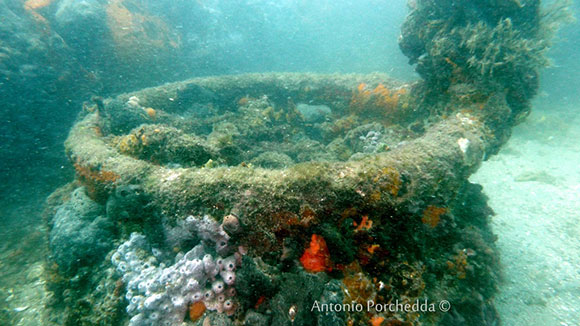
One of the four Pratt & Whitney R-1830-65 engines
It developed a power of 1200 hp
The cabin and fuselage, although partially destroyed, are quite distinguishable:
one of the pilot's seats is on display; I think to myself: "seems
almost a Mayan throne".
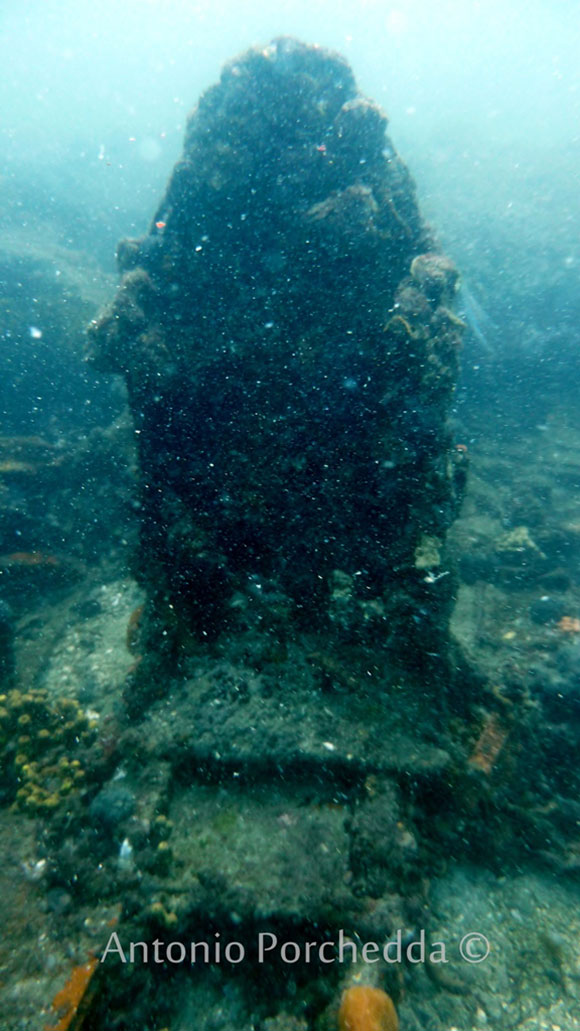
The cabin and cockpit, although partially destroyed, are quite distinguishable.
and one of the pilot's seats is on display; between me and myself I think "it almost looks like a
Mayan throne”
I wander around a bit to get my bearings and decide to start exploring the wing.
left: maybe it's just my perspective, but I see it higher than the right one.
However, I manage to slip under it and immediately take some photos of the cart.
half-closed, still in place. The design of the
tread, now mainly colonized by the red encrusting sponge “Aliclona”.
Originally the single wheel was completely retracted into the wing.
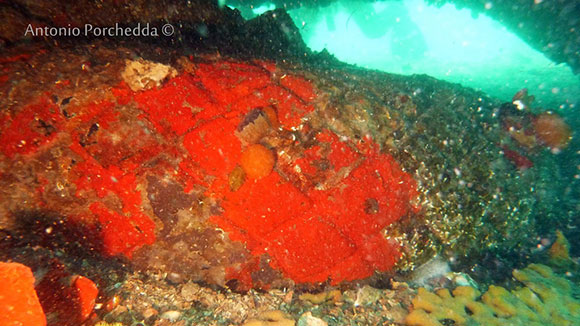
The tread pattern is clearly visible, colonised by the sponge
encrusting
“Red Aliclona”
The landing gear of the B24 Liberator consisted of another landing gear
similar to this one, placed on the right wing, and by an additional nose gear,
always with a single wheel, which was inserted into the nose, of which however I did not find
track. It was basically a tricycle.
Between the trolley just seen and the cockpit, my attention is drawn to a
large grey tube, about 15 cm thick. Since everything around is covered with
multi-colored encrusting sponges, I make the most absurd hypotheses about the presence
of this “artifact” so clean and shiny!
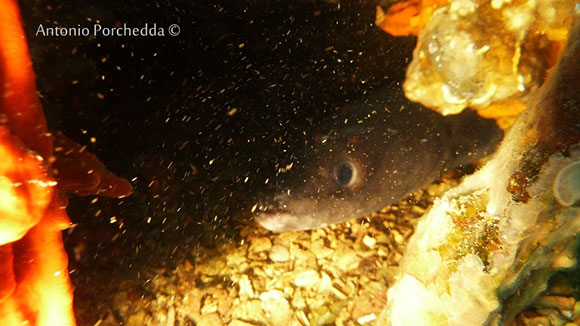
Conger conger
Instead, it is the lightened and age-marked livery of an elderly man.
Conger eel, which, flowing like a conveyor belt, finally shows me the
large head. Not at all frightened, the animal backs away completely,
he disappears between the sheets of metal, then reappears to make me “cuckoo”.
I manage to take just a couple of photos, not very nice unfortunately, but useful for the purposes
of the identification, which confirms the presence of this species of "bony fish"
inside the wreck.
I continue my tour following the profile of the wing, and under it, a cloud
of chestnuts darts outward, dazzled by my headlight.
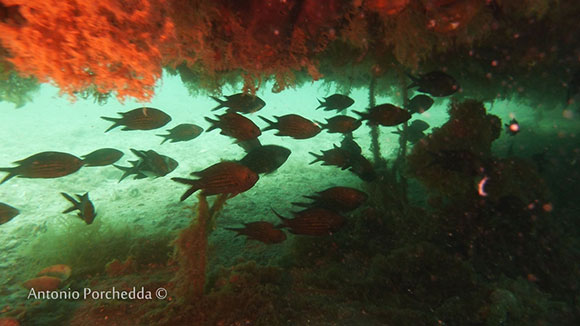
damselfish
A little further on, I reach the end of the wing, broken at the tip, and observing
the internal structure; the classic oval holes of the frame are clearly visible
reinforcement.
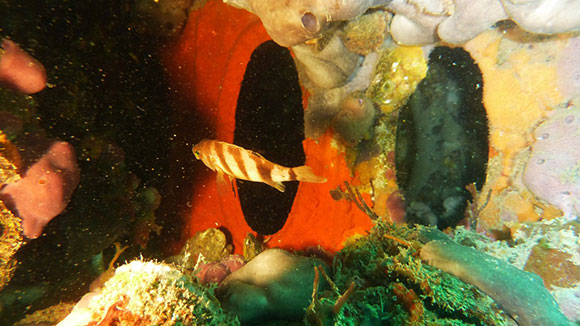
Here's a Bag fish that pops out and goes away!
And to think that originally, the wing cavities of this bomber housed
the fuel that powered the four engines, capable of giving this
aircraft weighing 29484 kg (fully loaded at take-off), 20.47 m long and 20.47 m wide
33.52 meters (wingspan), a maximum speed of 467 km/h.
It's really beautiful, I like it! I continue my tour and return to the cockpit.
keeping myself high on what must have been the flaps, now welded
permanently to the rest of the structure from benthic organisms: here the wing is
almost collapsed on the sand. In the center of the cockpit the wreckage becomes more
indefinite, in fact, and the tail is completely missing.
"Since I couldn't explain this particular thing, being
the airplane placed on the bottom in flight trim, after the dives,
I did a more in-depth search and discovered the following website
which covers the topic very well: www.archeologidellaria.org.
Consulting the forum on the characteristics of the B24, Mr. Freddy,
very kind and expert on the history of these and other aircraft and their
employment during World War II, he provided me with the following explanation
which I transcribe faithfully: the lack of the tail indicates that the pilot had
made an emergency landing; the B-24 was in fact sadly known for the
its particular tendency to break in two during landings, so much so that in
operating manual delivered to the pilots, there were specific instructions to which
comply in case of forced ditching”
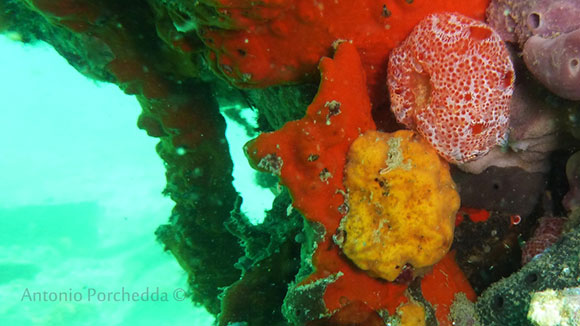
Colony: “Aliclona rossa”- “Aplidium elegans”- “Aplidium conicum”
Furthermore, thanks to “Wikipedia, the free encyclopedia”, I learned that access to
the flight crew was placed in the rear part of the aircraft, and
the crew, to reach the cockpit, went through a passage
very narrow. In case it was necessary to jump out of the plane in
flight, this was the only escape route, and with the parachute on, the
possibility of saving themselves was compromised. For this reason the Liberator came to
sometimes nicknamed “The Flying Coffin”.
The plane had another weak point, the bomb bay openings: these
doors, during the landing, were subjected to increasing pressure with
the impact on the surface of the sea, this caused it to break.
took on a huge amount of water which ended up in the rear part of the
tail, consequently, this area broke away from the rest of the fuselage.
I fly over (it's really the case to say it) the second wing, lower than the first: here
the flap area is almost completely under the sand, while the upper part
(I assume an inclination of about 30° and a height of about 150 cm) it appears to me as
a little terrace in bloom, like one of those you see in Trentino.
Here there are many animal and plant species, the true masters of this
wreck.
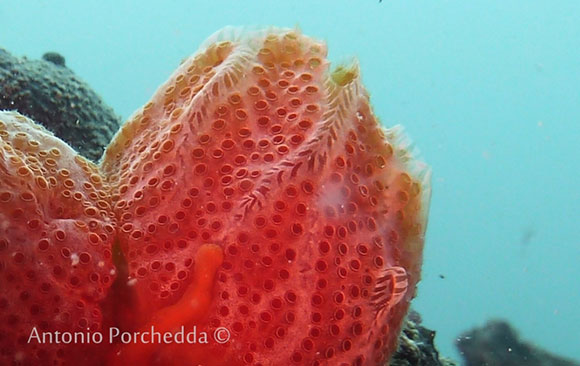
Ascidian “Aplidium elegans”
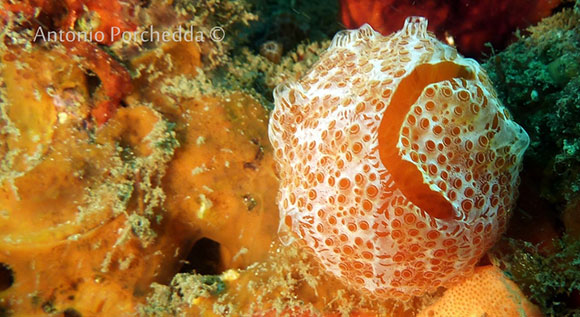
Ascidian “Aplidium elegans”
Seen from this side, the wreck doesn't even look like an airplane, but a rock.
sloping, covered with a multitude of marine organisms: it's a spectacle!
and again, under the wing, convinced that it had not been seen, a red scorpionfish.
I've been at twenty meters for more than an hour now and I can't hold back any longer, but first
to return to the anchor to begin the ascent, I do not miss any
another detail. Not far from a series of undefined wrecks, it looks beautiful
shows a gear, also completely encrusted but still well defined
after 69 years of sea water, and finally, the only identification plate
still present on the wreck, having jumped onto one of the engine oil tanks.
From this last and only clue, some fans like Mr. Freddy, already
mentioned above, they managed to identify the wreck, but not the exact
model, since the aircraft has been looted several times over the years and is missing
then, all other reference plates.
I think I will return to dive on B24 again, to look for new clues and
explore the area all around, perhaps with a radius of 200/300 meters, since
There are certainly interesting things to discover and new details to add
to this beautiful experience. And then, I have to find the queue!!!
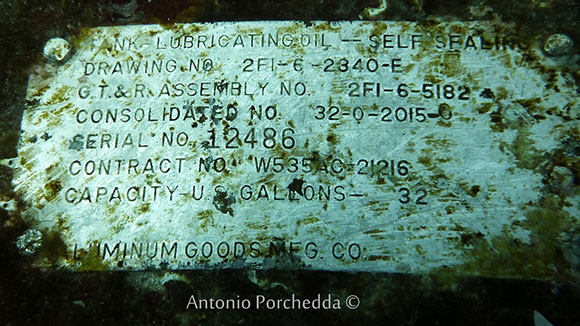
Tank plate
Reproduction is strictly prohibited, even
partial, of the text and images in this article without the author's consent.