




Author: Leonardo Olmi
Photo author: Erik Henchoz
Tired of Sharm and Hurghada? Then head to Marsa Alam, the Red Sea's newest diving destination, where you can now stay in comfortable resorts, rely on the expertise of Italian diving centers, and explore deserted beaches as well as pristine reefs that hold some wonderful surprises, such as longimanus whales, dugongs, and dolphins.
Here I am, finally on a flight to the much-vaunted Marsa Alam, the new Red Sea destination for tourists seeking new adventures and divers seeking new reefs and new thrills. Enough with the usual Sharm and Hurghada! My small team of five divers—three women (Francesca, Giovanna, and Alketa) and two men (myself and the legendary Marco Tarantino)—and I armed ourselves with cameras and underwater video cameras, packed our bags with few clothes but plenty of masks, wetsuits, fins, and so on, and dove into the middle of the desert south of Egypt. Underwater, we relied on the expertise of a truly professional, all-Italian diving center, Diving Ocean , which, not coincidentally, is located within the Tulip Resort.
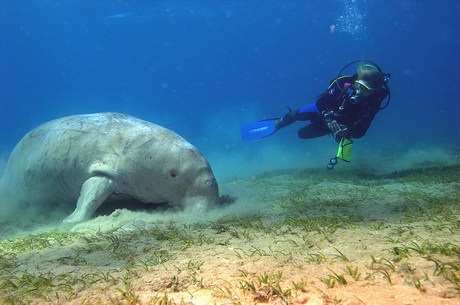
Photo by Erik Henchoz
Marsa Alam is located about 300 km south of Hurghada and can be reached by a direct flight from Milan Malpensa in just five hours. Marsa Alam is actually nothing more than a fishing village; the best-organized town, so to speak, is El Quesir, with its mosques and markets, located halfway between Hurghada and Marsa Alam. Here, there's still a traditional atmosphere, aimed at respecting the Muslim faith while somewhat flaunting its openness to tourism. Be careful, for example, not to photograph a woman walking down the street; her husband wouldn't appreciate it. The airport is new and well-organized, reminiscent of the old Sharm of fifteen years ago. In fact, it's expected that the same results achieved in Sharm will be achieved here, more or less in the same timeframe. The ports of Galeb, Naaba and Marsa Alam are slowly being developed, and will house shopping centres and luxury hotels. They will also be (although some already are) the starting and arrival points for all diving cruises aimed at exploring the most beautiful reefs in the area.
Aside from the airport and the town of El Quesir, all around is desert and the endless blue expanse of the sea. A single straight road close to the coast separates the mountains and sand dunes from the coral reef that borders the southern Red Sea. Every now and then, a resort breaks the monotony of the landscape, and a few blue signs with white lettering, half in Arabic and the other half in Latin, indicate our position based on the distance from Hurghada or Marsa Alam. As we get closer south, toward the border with Sudan, the barriers and police checkpoints increase. Just south of Marsa Alam lies one of the most heavenly and beautiful places in the area, Sharm El Luli beach. Here, the only sound is that of the sea, and the only colors are the gold of the desert sand behind us and the blue of the sea before our eyes. It won't last long; blessed are those who have been there and those who have seen it. Although the government is controlling tourism development along Egypt's entire southern coastline, here, as in Sharm and Hurghada, in a few years we will find a few resorts and shopping malls that will overshadow the pristine and wild beauty created by nature.
The same can be said for the coral reef, still largely unexplored, which offers divers the opportunity to visit sites that until now have been visited only by a fortunate few and are still largely unexplored. Among these is the much-vaunted Elphinstone Reef, where, in addition to a seabed colorful with numerous soft corals, you can encounter the coveted longimanus. Then there's Abou Dabab, where you have the chance to encounter the tender yet rare dugong. And finally, Dolphin House, home to a large colony of beautiful dolphins. It was precisely with regard to these dolphins that Diving Ocean first raised the alarm in 2002, calling for the public to adopt a code of conduct towards dolphins to ensure their protection. In November 2003, the area was finally and rightly regulated with the positioning of some buoys that circumscribed it, imposing rules that prohibited diving and allowed only snorkeling and a limited number of boats for daily access.
In the early days of underwater exploration in southern Egypt, one could only rely on long boat cruises, which, departing from much further north, required tourists to spend many hours at sea. Alternatively, certain dive sites were only accessible by land, with makeshift dive centers set up in tents in the desert and very uncomfortable accommodations. Today, however, Marsa Alam, with its airport and limited number of modern resorts, has achieved the perfect balance between comfort and nature, which we hope will remain that way and not be lost. Diving Ocean provides minibus transfers directly from the hotel to its three boats, which, being located in the three ports of Galeb, Naaba, and Marsa Alam, can cover a full 75 km of coastline. This is the exception to the Elphistone Reef, where Diving Ocean uses a dinghy. The boats used by the dive center are very similar to those used on liveaboards, ranging from 15 to 25 meters in length.
Complimentary snacks and drinks are served on board. But what more could you want?
THE MOST BEAUTIFUL DIVES
Marsa Mubarak
This dive site can be reached from Galeb Port in a comfortable 15-minute boat ride. It's a bay magnificently protected from varying sea conditions, capable of satisfying both experienced divers, with its walls along the outer, deeper edges of the reef, and beginners, in the shallower, more sheltered interior waters of the bay. Marsa Mubarak has a total of five different dive sites. On both sides of the bay are beautiful coral gardens and numerous madreporic formations, around which, naturally, many of the Red Sea's diverse reef fish species thrive. The southern section of the bay is the one most exposed to currents, and therefore offers the greatest chance of encountering pelagic fish, including a population of bottlenose dolphins that come to this area during the day to rest, often choosing to interact with lucky divers and snorkelers. Marsa Mubarak, characterized by dense seagrass beds, is also an excellent refuge for the much-coveted dugong. This dive site is predominantly characterized by the presence of various species of hard corals, including numerous fire corals, and a few dull, dimly colored alcyonarians. In addition to abundant reef fish, anemones, and their clownfish, crocodilefish and pufferfish often rest on the sand near the bottom, while various species of gobies peek out from beneath.
DEPTH from 5 to 25 meters
CURRENT: nothing
VISIBILITY: good
DIFFICULTY: minimum
Marsa Shoona
We embark from the port of Galeb and sail south for about thirty minutes. The scenery here, like that of Mubarak, is very similar, with a sheltered bay offering both experienced and novice divers two options: the outer reef or the inner bay. There are slightly fewer essential dive sites, only three: one more sheltered inside and the other two further out. The northern side of the bay offers a greater variety of corals, including many fire corals, while the southern side, in addition to truly spectacular coral formations, offers more reef fish that find shelter from the currents here. During our multiple dives along these reefs, we noted the presence of numerous brown rays with blue spots, large moray eels, groupers, and the typical pairs of butterflyfish of the Red Sea, the beautiful Golden Butterflyfish.
DEPTH from 5 to 25 meters
CURRENT: nothing
VISIBILITY: good
DIFFICULTY: minimum
Elphinstone Reef
To expedite the trip to this reef in the middle of the sea, Diving Ocean uses a large, fast inflatable boat that allows you to reach this dive site in just thirty minutes of sailing from Naaba Bay. The reef extends from north to south, parallel to the coast, for about 200 meters, and its maximum width is approximately 15-20 meters. Along its eastern and western sides, it has two vertical walls that drop into the blue, while at its northern and southern tips are two plateaus at around 15 meters deep, from which a wall plunges back into the blue. Encounters with sharks are not uncommon along these areas, including the coveted longimanus and hammerhead sharks. Among the pelagic species, schools of barracuda and jacks can also be encountered, as well as many species of reef fish. Large, colorful soft corals abound, the most beautiful being found below 20 meters, while closer to the surface, brown ones dominate, often surrounded by dense clouds of anthias. Visibility is usually excellent, but the strong currents that can sometimes invade this stretch of open water make this dive recommended only for experienced divers.
DEPTH from 5 to 40 meters
CURRENT: strong
VISIBILITY: excellent
DIFFICULTY: medium
Abou Dabab
This area can also be reached from the port of Naaba and consists of the seven outer reefs of Abou Dabab and the two innermost reefs of the bay of the same name. These dive sites are characterized by circular coral formations, which in turn are surrounded by submerged pinnacles. The dives here are very easy and shallow, no deeper than 20 meters, but no less interesting than the other dives. In fact, one of the main features of this area is the greater likelihood of encountering dugongs here than anywhere else. This area is surrounded by large sandy areas with thick seagrass beds, the ideal habitat for dugongs. The dugong, for those who don't know, is a herbivorous marine mammal, very curious in appearance and completely harmless. It is extremely rare and survives only here and in a few other places on the planet. Along the seabed of this dive site, if we aren't lucky enough to see dugongs, we will almost certainly encounter large green turtles, often accompanied by their remoras.
DEPTH from 5 to 20 meters
CURRENT: nothing
VISIBILITY: good
DIFFICULTY: minimum
Samadai or Dolphin House
This is both a diving and snorkeling spot, and can be reached from the Marsa Alam port in a 50-minute boat ride. It's the southernmost point in the area. The location is also known as Dolphin House due to its large population of Stenella longirostris dolphins. As mentioned above, this entire area is considered a protected marine park, and access is permitted only to a limited number of boats and tourists per day. The area where dolphins are usually found is accessible only by snorkeling, but you can't go beyond a line marked by buoys. Dolphins are typically very curious and playful, approaching tourists to within a few centimeters of them, making Samadai a truly touching and unforgettable experience. The reef is crescent-shaped, and diving is permitted only along its outer walls at the mouth of the bay, where shallow, easily accessible caves open up. This creates beautiful light effects, with the sun's rays filtering harmoniously through the surface. The corals are beautiful and lush, as is the reef fauna. While diving, you might even encounter dolphins, intrigued by our bubbles.
DEPTH from 5 to 15 meters
CURRENT: nothing
VISIBILITY: excellent
DIFFICULTY: minimum
USEFUL INFORMATION
WHERE IT IS LOCATED: Marsa Alam is located in Egypt, 300 km south of Hurghada
HOW TO GET THERE: Marsa Alam is easily reached by direct flights from Milan Malpensa and Rome Fiuminico. The flight takes about 5 hours. We will then be transferred from the airport to the Tulip Resort in just 15 minutes by bus.
DIVING CENTER: Diving Ocean
tel.: +20-12-796.6090 / +20-12-748.4335
www.divingocean.com / info@divingocean.com
The center is located directly inside the Tulip Resort. It has three large boats and a dinghy, and provides free transportation from the hotel to the dock via a small bus. It offers courses for all levels and equipment rental. Its guides and management are all Italian and highly professional.
TONGUE :
The official language is Arabic, although almost everyone speaks English and many also speak Italian.
CURRENCY :
The Egyptian pound, called guinea in Arabic, 1 guinea = approximately 0,50 Euro
REQUIRED DOCUMENTS: Passport valid for at least another 6 months. A consular visa is required, which can also be obtained at the airport for £40.000.
REQUIRED VACCINATIONS:
Nothing in particular
CLIMATE: Dry and arid
WATER TEMPERATURE: Summer: 26-28°C
Winter: 22-24°C
JET LAG :
+ 1 hour compared to Italy.
WHAT TO BRING:
Mostly summer clothing, with a sweatshirt for evening wear if we're going in winter. Always bring a good sunscreen.
WHAT
BUYING: Among the local handicrafts we will find carpets, copper and silver objects, and the typical paintings on papyrus paper.
WHAT TO SEE:
The town of El Quesir and the beautiful beach of Sharm El Luli.
HOW TO CALL: To call Italy from Egypt, dial 0039 before the desired number, including the area code. To call Sharm El Sheikh from Italy, dial 0020062 plus the desired number.
RECOMMENDED BIBLIOGRAPHY: Red Sea Diving Guide: (Italian)
Shlomo & Roni Cohen, Ed. Seapen
The dive sites of the Red Sea: (English)
Guy Buckes, AA Gaddis & Sons Publishers
TOURIST OFFICE:
Egyptian Tourist Information Office
Via Bissolati, 19 – Rome – tel. 06-482-7985
Reproduction of the text and photos in this article, even partial, is strictly prohibited without the author's consent.