


Author: Francesco Turano
Alicia mirabilis, queen of the night
There are things underwater that you can only see at night.
I realized this when I was thirteen, the year I took my first night dive. A dear family friend, a passionate spearfisherman, lent me a wetsuit I could fit into a couple of times, and a spring-loaded speargun (the Cressi-Sub Minisaetta); the mask and fins were my own. They took me to see a classic environment of rock, sand, and seagrass, on the Ionian coast of southern Calabria. I had about three kilos of ballast and a ridiculous flashlight, but an exceptional support vessel: a fisherman's gozzo complete with a lampara, which illuminated the seabed beneath us like bright lights down to a depth of six or seven meters. The boatman rowed, and my dad's friend and I swam on either side of the boat, looking for prey to spear. It was July 1978 and I will never forget that day, even though I was having difficulty freediving due to the lack of weight I was wearing and the cold-water circulation suit…
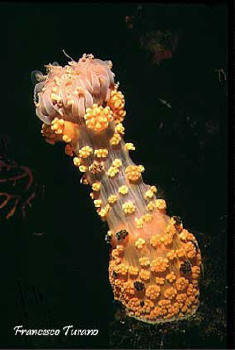
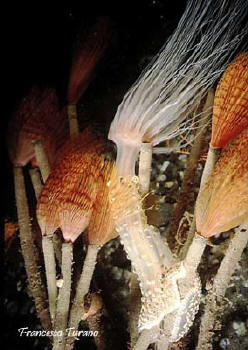
Since then, night has always been a magical time for my dives. And among all the exclusive encounters in the kingdom of darkness, the one with theAlicia mirabilis It is certainly one of the most intense and moving, even today. With a beautiful image of this rare anemone, I won my first national photography competition in 1992. But my love for this rare coelenterate had already been budding for some time… It could be called the “queen of the night” due to its habits, which are exclusively tied to the dark. By day, contracted and insignificant, resembling a flattened pine cone and completely inactive, it transforms at night, expanding its cylindrical, gelatinous body, swelling with water and growing 10 or 20 times its dormant size. From the apical tip of the stem, a series of long, extremely thin, super-stinging tentacles extend, which, in the dark, unleash themselves, floating in the current to catch food.
Observing one of these anemones with its tentacles moved by the current is a spectacle that few divers have the opportunity to witness.
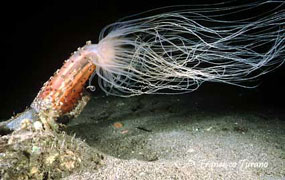
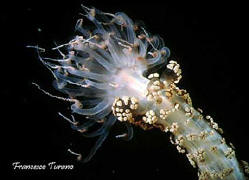
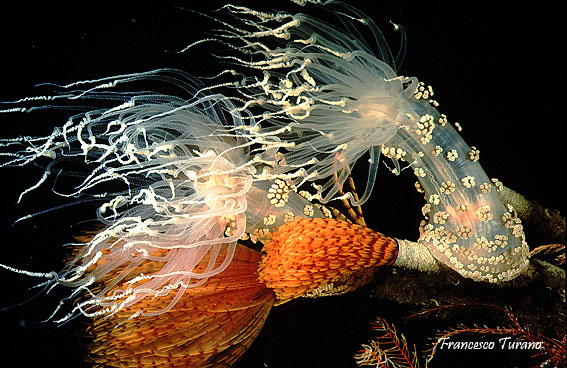
The delicate shapes and colors are unique among anthozoans; the body is striated and covered with dark glands, usually brown, but also orange, white, and even black. The base features a pedal disk, typical of all anemones, which in this case is used most often for movement, which is quite frequent for a typically sedentary animal. The choice of a perch depends on many factors, although the most important remains food capture. For this reason, the anemone always attempts to reach the highest possible position above the seabed, using anything within reach: a rock, a gorgonian, the tube of a fan worm, algae, or a leaf of seagrass; anything works as long as the perch is as high as possible above the seabed. Sometimes I have come across the anemone with its base adhering to the float of an abandoned net or to a bottle lying on the bottom or even, by chance, to the shell of an unfortunate hermit crab or on the carapace of a crab, even if in these cases we are faced with exceptions, given that the Alicia mirabilis does not generally require the movements performed by the invertebrates that host it.
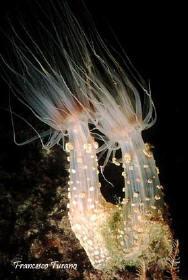
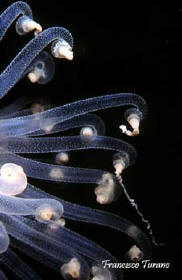
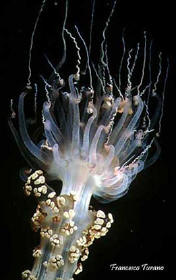
The animal's size varies from specimen to specimen, with adult specimens reaching 40-50 cm in height, excluding tentacles; the latter can exceed a meter in length. Extremely powerful and extremely thin, the tentacles form a deadly net for all small creatures caught in the currents. Underwater, by shining an artificial light on the Alicia mirabilis , many incredible scenes can be witnessed, first and foremost predation. This is thanks to the power of light to attract small crustaceans or worms, wandering in the night. These tiny plankton are struck by the anemone's tentacles, before our incredulous eyes, which allow us to witness all the stages of food capture. At the slightest impact, the tentacles instantly contract and curl, channeling the captured animal towards the mouth.
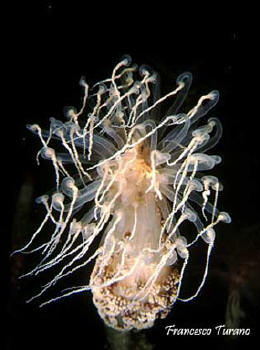
Regarding its presence in the Mediterranean, it was initially reported in the Gulf of Naples and the Gulf of Marseille (in the 50s), and its distribution is now known to extend as far as Gibraltar. Less well known, however, is its widespread presence on the seabed of the Strait of Messina, where I have contributed several times to reporting its widespread distribution in all types of environments. Reports elsewhere are occasional and sporadic. As for its habitat, it prefers shallow, detrital seabeds with strong currents, but it does not disdain sandy or rocky environments.
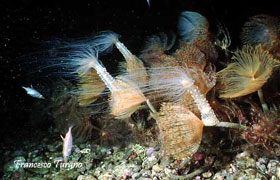
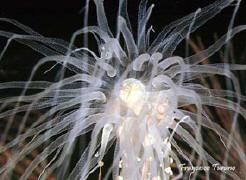
The usual depth at which the Alicia is found ranges from a few meters to 50-60 meters, but even today, very little is known about its biology. Direct observations I've repeated over the years, in the wild, in the waters of the Strait of Messina, have allowed me to learn only a little about this rare coelenterate. For example, I've noticed that it's often easier to find larger specimens at deeper depths. I've also noticed differences in color related to who knows what.
The most beautiful thing I ever observed was the presence of several anemones sharing the same substrate, managing to observe and photograph up to four specimens all together, one next to the other. I still remember the time when I photographed what I called the "poker" of Alicia mirabilis, in the sea off Reggio Calabria. I shared the experience with some friends, and they too have a filmed memory of what I showed them during those extraordinary night dives, where the wreck of an abandoned net, with its now encrusted floats reaching upward, offered the ideal substrate for four magnificent anemones, the subject of some of the rarest photographs I've ever taken. Today, I have over a thousand shots of this rare creature in my archive, and each one is linked to a story, the memory of a night, a scene, a life experience in the magical underwater world of the Strait.
Reproduction of the text and photos in this article, even partial, is strictly prohibited without the author's consent.